Friday, February 15, 2013

Song of Elmallah, image 2

I continue to develop the images to illustrate Bouk 1 of The Song ov Elmallahz Kumming. Below is the second image, but first, perhaps these brief technical notes will help the reader/viewer understand a little better what I’m trying to do.

My poetry is highly layered, like a painting that uses multiple thin layers of translucent color to build up depth and accuracy of image. Our “seeing” of the world, in the same way, is a complex interpretive event, that lays narrative and value into sensory inputs. Our senses are not clear windows on “reality”. They are lenses with a large, mostly unconscious set of filters, in place at the outset by a synapsed nervous system, and then built up thru layers of mind (a crude list): emotions, needs, intellect, experience, conscience, soul/spirit (a vague term because our tools are weakest here).

I try to diffract and expose some of this thru my images, both textual and visual. In the visual image below, the abstract “background” is the chaos, the tohu and vohu, the perspective-less consciousness out of which we create narrative. In this image we discern three women, and with the poem as background, we can construct a tenuous narrative out of the atomized and incoherent ground in which they are embedded.

The image below, entitled Arrownd Her Klay Silluwet, accompanies the following lines that can be found in the early part of the poem, when Elmallah (an angel descending from the upper genomes) first encounters Ertha:


I ternd awway
But agen loukt bak.
    Wen Lots wife loukt bak
    Tu the Soddem that she fled,
    Her Sol kristeld in salt.
    Wen Polladekteez ternd frum revvelree
    Tu reseev hiz gift,
    Proteyus held the hed ov Meddusa
    And froze him intu stone.
    Wen Eddippus ternd and staggerd
    Frum the bed ware he
    And hiz muther had lain,
    He gowjd hiz eyz with redhot pinz.
Wen I loukt bak
Her tangeld hare wuz kut and koemd;
Her hed wuz bownd in kloth.
Her hips, her legz, her kumlee brests
Wer titelee rapt in dust-brown muzlin.
Akros her fase emotenz rippeld
Like wind akros the surfas ov a bay.
But arrownd her klay silluwet:
A korrona, like the Sol in eeklips.
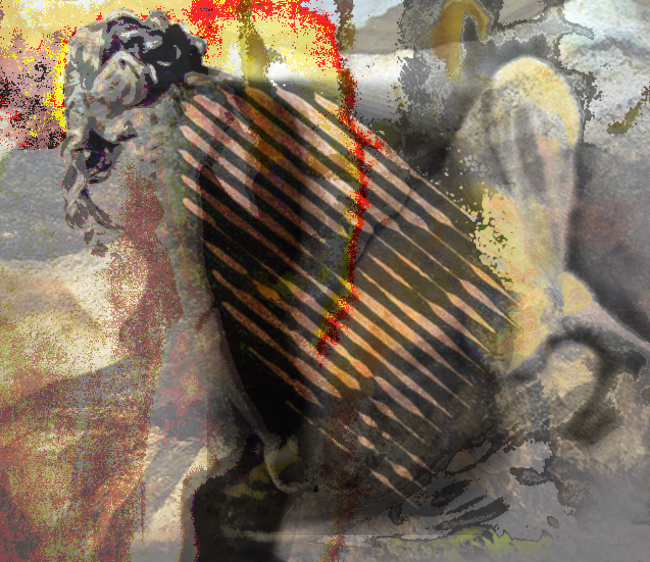


(In most browsers, if you click on the image you can view it in larger format.)

Monday, February 11, 2013

pups rough-housing

Just a little fun, here, to lighten the day...
Sanani and Nikki duking it out, 2 videos:


Sunday, February 10, 2013

Song ov Elmallah, image 1

Last night I completed the following image, to be embedded in an upcoming ebook, The Song ov Elmallahz Kumming, Bouk 1.

The image (below) will accompany the opening stanzas of the poem:


Az if the sunrize
Had not yet begun
And thare on a hill,
Ware the ful moon hung
Entangeld in parcht akkasiyaz,
She muevd, her owtlienz obskure.

Az if thay wer smoke,
Frum a smoldering fiyer
Koiling in kazhewal ternz
Like tendrilz abowt the akkasiya branchez,
Her thots drifted in that wilderness.


Saturday, February 02, 2013

Song ov Elmallahz Kumming: video 2

On 1/31/13 I posted a video for my ebook of Bouk 1 of The Song ov Elmallahz Kumming. Here is a slight revision, with altered text fonts, based on your feedback:


Thursday, January 31, 2013

Song ov Elmallahz Kumming: video

I am preparing an ebook edition of my poem, The Song ov Elmallahz Kumming. Actually, it will be 6 ebooks, one for each book of the poem. The first book is the shortest, about 300 lines or 8 pages. However, the ebook will have both stevetok and normtok versions, audio tracks of the poem in 2-4 stanza clips, a complete reading of the poem, and will include many illustrations and images as well. It will also include at least one video, an impressionistic interpretation of the opening scene of the poem, 28 seconds long (without title and credits, which I'll add later).

Here's the video. Naturally, I would greatly appreciate your critical feedback.


Sunday, January 27, 2013

Portraits from a wedding

This excerpt from The Atternen Juez Talen is a scene from a marriage celebration from 1000 years ago in North Africa.

Thaerz the bodlen* drapen a suet a rag
                * wedding jester
Pachez an nots an haengee strips
Like the ruffel fetherz ov a troppikkel berd.
Him poze, him strut, then poze aggen
Az he mixxen Torrah an bawdee vers,
Shokkenz, an shor az maeks us howl.

Then thaerz the rabbiy loukenz askans,
Him fase as twistee az the Torrah he heer,
With him ekot terben in a brikwerk a shaedz
Ov skarlet an goel, a keenglee krown.

Arrown the tabelz awl pilen a foodz,
The povverish wunz with krustee naelz,
Thaer kallas hanz awl kreest an krakt,
A happallee slerpenz tanjeen and wienz.
An ammungst them, yungsterz grabben sweets,
Thaer cheeks a-bulj an krumz on thaer chin.

An thaer, dansen, like berdz aflok
Divenz an arkenz ov a seengel mien,
Or like skoolz a fish that dart an kerv,
The dansee madenz, aswerrellee skarvz.

An off tu the siedz the kroonen kroenz
With thaer goelden baengelz an hennah hanz,
The koel darkt iyz an silkee shawlz
A-weev in artfule jeyommetreez,
Like the taengellee branchenz a baren treez
Or the win-tos spray in the krash a waev.

An now the reb with krumz on iz chinz,
The yung boy, awl nottee thaer beerdz an grinz.
The kroenz dansen in thaer raggee kloeks.
The madenz a-talen thaer bawdee joeks.
The bodlen sidelz up tu my deer
An kissen her cheek an they dissappeer.

Wednesday, December 05, 2012

The Akedah

The following is a short midrash (literary exploration/expansion) on the biblical story of the Binding of Isaac (Yitzkhak), that is, when Avraham is tested and takes Yitzkhak to sacrifice him. The brief story can be found at Beraysheet/Genesis 22:1-19. 

Like so many biblical tales, there is much more left out than told. The text, translated by Fox, says, 22:3, "He saddled his donkey, he took his two serving-lads with him, and Yitzkhak his son..." Of course, the rabbis have been asking, lo these thousand years and more, who are these 2 "serving-lads"? Equally (or more) provocative, the tale says nothing from Yitzkhak's POV, and indeed it concludes with this, 22:19, "Avraham returned to his lads and they arose and went to Be'er-Sheva." Where's Yitzkhak?? These, and many other questions are much commented upon.

One existing midrash suggests that one of the "serving-lads" was none other than Ishmael, Yitzkhak's half brother. Another (unrelated) midrash suggests that Hagar, wife/concubine/servant of Avraham and mother of Ishmael, is an Egyptian. Those 2 little details should provide you with sufficient points of entry into the following:

When Avraham took Yitzkhak, along with Ishmael, a servant, and a donkey up to Mt. Moriah, he said to his Egyptian son, "you stay here with the donkeys, while I take this one up." Then Ishmael cried, "What about me father?! Is there no blessing for me?"

Avraham sternly replied, "Stay with the donkeys."

Avraham and Yitzkhak returned the next day, and Ishmael saw the horror in his brother's eyes. He thought to himself, "This is a God I should fear, and this is a father I should fear. This is a God, better to know from a distance, and this is a father better to keep at a distance."

And they walked back to Be'er-Sheva in silence.

Thursday, November 22, 2012

Response to article in Middle East Star

The Middle East Star, on 11/21 published an article entitled:
Hamas should be engaged by Israel – by Ed Husain
I genuinely believe the author does not consider himself an enemy of Israel, but rather an Arab voice, probably a lonely Arab voice, seeking peace. But like a fish that is unaware of the water in which it swims, the author, in reality, remains a voice of Arab hatred and oppression of Israel and Jews.

The whole article can be found at:
http://www.middleeaststar.com/index.php/postc/210875107/scat/940f2bfd509e743b
Here are some critical excerpts that are revealing of the omnipresent hate driving the Arab (and Muslim) world. After these excerpts (in italics), you can find my response.

... I can name tens of Muslim clerics, important formulators of public opinion in a region dominated by religion, that will readily condemn acts of terrorism against the West, but will fall silent when it comes to condemning Hamas or Islamic Jihad. Put simply, support for violent resistance against Israel among Arab and Muslim-majority countries -- including allies of the United States such as Qatar, Saudi Arabia, Egypt, Turkey, Tunisia -- remains popular.

... From radical Iran to moderate Tunisia, Hamas' Prime Minister Ismail Haniyyeh was welcomed by vast cheering crowds during visits this year.

... Israel needs to change. ... A tiny nation of seven million [Israel; 5.25 million Jews] cannot be allowed to damage ties between 360 million Americans and 300 million Arabs.


Here is my critical response:

As ever, the author, although I don’t doubt that he is well-meaning, has it all backwards. 300 million Arabs and 5 million Jews, but our author says the Jews are the problem, not the Arabs! Why are the Jews a problem? Because they are a minority in a region that only knows oppression of minorities. Ask any Copt, any Kurd, any Assyrian Christian. Indeed, ask any Sunni in a Shia country, or Shiite in a Sunni country!

And of course, it is not Israel that "damages ties between 360 million Americans and 300 million Arabs," as the author would have us believe. It is the hatred, violence, and intolerance of the Arab people, institutionalized by governments, mosques, media, and schools that has damaged ties.

Mr. Husain, YOU are the problem, and you are its clearest symbol. You expose with complete clarity the absolute refusal of the Arab world to look at itself and realize how sick, how immoral, and how dysfunctional it is. Until THAT changes, Israel will be just one more excuse for Arab dysfunction.

Tuesday, November 20, 2012

From The Atternen Juez Talen: Ketuba

In this brief scene the Atternen Ju, who is getting married, watches as his ketuba (marriage contract) is produced by a scribe. The first version is in meta-English, followed by a standard English version. For all you calligraphers and sofers...

Meta-English (Stevetok) version:
...
The skrieb hav a hole jarfule a penz
An a mennee bottellen ov eenks, az wel.
An not a sheet a linnen, starcht,
But rit on a parchmen skind ov a goet!

He puelz owt a goos kwil an kaerfule inspeks;
Sharps it a bit; then a dipt in eenk,
Shaeks it, an taken a long deep breth.
Fliez forth him han, like a swawlo that dievz
An sord thru the aerz, dip an fly,
Dip an fly, an thaer on the parch
A weengen chareb toppen the page.
Then annuther pen in annutherren jar
An annutherren sereez ov shaek an fly.
An wo! the chareb lumen in goel;
An with a flik he a spatterren, starree a sky.
Then, with kaerfule, a mezherren stroek
Larjen letterz in lappis blu,
Youd hay vuv hay*, the holeyes Name
                * Hebrew letters, code for ineffable Name; 

                spoken: Uddoniy
Between the owtstrechen chareb weeng.
Then in a liten a shaden a blu,
El Shuddiy, the nercherres Name
In smawler letter inside Uddoniy.
Now kum the marij kontrak tex,
Awl bizzee an aeree an fule a pomp,
‘Waerfor this’ an ‘waeraz that’
In blak letterren, smawl an skware.
Then zigzag an swerrel tu border the siedz,
An heez dun, we sine, an I’m a mareeyes man.


Standard English (dulltok) version:
...
The scribe has a whole jarful of pens
And many bottles of ink, as well.
And not a sheet of linen, starched,But written on a parchment skin of a goat!

He pulls out a goose quill and carefully inspects;
Sharpens it a bit; then dips it in ink,
Shakes it, and takes a long deep breath.
Flies forth his hand, like a swallow that dives
And soars thru the air, dip and fly,
Dip and fly, and there on the parchment
A winged cherub atop the page.
Then another pen in another jar
And another series of shake and fly.
And whoa! the cherub illumined in gold;
And with a flick he spatters a starry sky.
Then, with careful and measured strokes
Larger letters in lapis blue,
Yud hay vuv hay*, the holiest Name
                * Hebrew letters, code for ineffable Name; 

                spoken: Adonai
Between the outstretched cherub wings.
Then in a lighter shade of blue,
El Shaddai, the nurturing Name
In smaller letters inside Adonai.
Now comes the marriage contract text,
All busy and airy and full of pomp,
‘Wherefore this’ and ‘whereas that’
In black letters, small and square.
Then zigzag and swirl to border the sides,
And he’s done, we sign, and I’m a married man.

Friday, November 16, 2012

Eastern Shore, 2

Twilight and the Idols, aka some pics of Nancy, my BatKoel (with thanks to Gimp and Warhol and a perlee sunset):

Down by the reebop, I shot my babee...


An' now she begin tu tok tu me...


Oh yeah...


 The nazz ar blu, er, green... (you know that old Yardbirds song?)


Goelden gerl on em goelden sanz...


Sheez a raenbo...


Its a token for this short jernee...


G'by.

Eastern Shore, 1

Here are a few images of a short trip to the Eastern Shore of Virginia, and to a park at the southern tip.

 From our hotel room window:


On the trails in Kiptopeke State Park, a view up thru the canopy:


 Same as above, posterized:


 Kiptopeke overlook, facing inland:


 On the trails in Kiptopeke State Park, some cottony bushes:


Speaking of cotton, one a them ole cotton fields back home:


 Local groundcover:


 The inevitable sunset pic, from the beach just down the street from our hotel:


 Same as above, posterized:
 

Same as above, into pure energy:


b'deya, b'deya, b'deya... that's all, folks.

Wednesday, October 31, 2012

Images of my wife

For our 36th anniversary, I made a little card for my wife (sorry Hallmark, I NEVER buy cards). The cover picture was the Dancing Tara image I produced for my Ottoman Beachcomber ebook (you can view the image at: http://shivvetee.blogspot.com/2012/07/ottoman-beachcomber-4-images.html). Inside the card I printed out a small collection of excerpts of the many images of Nancy in my poetry. Below you can read those excerpts. You will see that the long poem, Song ov Elmallahz Kumming (written in 6 books) prominently appears in this collection. That's because the poem is all about us. Of course, Elegies in Nance, a 9 poem series, is also about us. And then there are many dozens of individual poems, and an untold number of images and scenes appearing in other long poems, including In the Ruwenz of the Tempel, I Herd... and The Atternen Juez Talen.

Thus:


From Weighing the Golden Thredz:
Her radient chambers, and the bed ov her luv
Ware she let fall her shados, and my Sol enkindeld with the lite.


From Elegy over the Sea:
Are the young girls now so fine as she, when I knew her?
Impossible to tell; I see her face in theirs.
She made me a pagan; I idolized her body.
And if that were a sin, I would not repent.
And though her face was pale it was yet more glowing
Than the worship of that God that made religion.


From Elegies for Nance:
Your body was the myth, I merging into it.
Your love was the liquor I drank till my mind swam with Ertha.


From Song ov Elmallahz Kumming, Bouk 1:
Az if erlee don and the faent kry ov loonz
Made faenter by vaperz that shrowd the salt marshez,
So her vois wuz vage, misteereyus.

Az if a wouman meerlee puling a brush thru her hare,
But in that deseptivlee simpel moshun
A meerreyad illuzhenz surrownded her prezzens,
Exerting thair powwer like a werlpull
Agenst my feer ov her inkoherens.


From Song ov Elmallahz Kumming, Bouk 2:
No! I wil not sing ov separaten. No, not ov sorro eether!
Let me tel yu how I luvd her, tel yu how it wuz between us.
In this way, perhaps, I kan sho yu wy it wuz I kame tu her.


From Song ov Elmallahz Kumming, Bouk 3:
Ritten the storee ov my huzbandz demize,
Him hu klaemd immorten knowen
And iz ded and awl hiz tablets ar krak....
Oenlee this tu tel:  wen, in my armz he lay
    And he wuz enlarjd,
    Awl the annallogz ov my luv
    Swam in hiz vaenz, awl the goedz
    Shot forth taelz frum thaer mowthz.
    Then I knu wut luv wuz!


From Song ov Elmallahz Kumming, Bouk 4:
Az if the wind wer bloing and stirring the surfas tu Life...
Az if an oyster wer openning tu offer up its perl...
Theyodorra rizez tu the surfas ov the see
Eskorted by dolfinz hu playfullee sport at the wotterz ej.
She standz in korrona ov jem-like droplets
And steps owt ov the kristellin See.
Her boddee iz koppergoeld, strong, and naked;
Her eyz ar dark with shaddoez;
Yu ar staring and she knoez it.
She iz akting; she iz perfektlee at eez.


From Song ov Elmallahz Kumming, Bouk 5:
O Ertha, O Ertha, abzorbd intu yur pashen
The werl iz bekum like a foggee beech.
Ware iz the Sol and ware ar yu
Hidden in the dens and dreemlike vaperz?


From Song ov Elmallahz Kumming, Bouk 6:
Now in the getto, now on the beech.
Now in the smoke stak, now in the see.
Awl her moments wash owt ov her skin.
She iz Eve, she iz Addom, she iz Erthah aggen.

Frum affar seez Erthah her Elmallah
On Mownt Hermoen in the rizzen sun.
And he seez her rizen like Venes
Frum the see, her Soel koyeld in the waevz.


From The Atternen Juez Talen, Era 5, Part 1:
Surah! Yur pure an holee waez
Ar but a fadee memmer now.
Her, hu iz my neshammah, Nayomee,
Thaer I fownd yu ferst.
Thaer ar abbundens, ar luv, ar chieldz
Ar trubbellee dayz, ar wizdem fule.


From The Atternen Juez Talen, Era 8, Part 2:
An then az if an aenjel fliez intu the rume an seeng a salm,
The dotter ov Shah-ool, Batkoel, enkwiyerenz

In a seeng-song toen, she, 
Huze vois I nevver herden, so sweet an perfek in akkord
An like an ood*, she strum my seel,
            * Middel Eesten mewzakkel instrumen
    "Tel me wut yur Surahz like." [she sez tu me.]

My tung, my miend, the herts ov me awl taengel up.
Wut kan I say? An wuns aggen my fase tern red
Az I simmerz in the spise ov her.

Aggen she laf in my un-eez, but not a sharp or pointee laf,
But like she touk my han an sez
    ‘I even like that part ov yu.'

Thursday, October 18, 2012

Genesis/Beraysheet: an analysis

The Torah is read weekly in synagogues around the world. Indeed every synagogue reads the exact same portion each week. To this end, the Torah is divided into sections, parshiot (singular: parashah), each of similar length. Now after the holiday of Sukkot (tabernacles) ending in Simchat Torah ("rejoicing in the Torah"), we begin again, as we do each year, at the beginning of the Torah, with the parashah named Beraysheet (common spelling: Bereshit), pronounced ba-RAY-sheet. It is probably one of the best known parshiot (sections), the story of creation, including Adam and Eve, the Garden of Eden, Cain's killing of Abel, and then the next ten generations of humankind.

The following is a kind of structural analysis of Beraysheet, ala Levi-Strauss. It is my preferred way of giving a first reading to a Torah text. I break the text into its component sub-documents, based on perspective, information content, grammar-structure, and questions the text appears to be addressing. I also try to make sure that I look at the text both from the point of view (pov) of an author writing the text (what am I trying to tell my readers?), and as a reader, asking why does the author think this is important.

So here is a structural analysis of Beraysheet, Genesis 1:1 to 6:8.

1:1 - 1:23      myth; cosmology; early science including origin of species, with evolutionary perspective; source material for this narrative includes texts and concepts from other cultures, and thus is highly layered and multi-cultural; for the relationship of myth to science, see Malinowski, et al.
1:24 - 1:25    classification of species
1:26              hierarchy of life
1:28              a blessing
1:27 - 2:8     continuing with myth-science
2:9                origin of ethics
2:10 - 2:14    geography and mapping; geology
2:15 - 2:17    divine origin of law
2:18 - 2:20    continuing with myth-science
2:21 - 2:22    surgery, medicine, bio-engineering
2:23 - 2:25    continuing with myth-science
3:1- 3:7        origin of deceit
3:8 - 3:11     awakening of self-consciousness; developmental psychology
3:12 - 3:20   first crime and punishment; also origin of dissatisfaction, sorrow, pain
3:21              origin of clothing fabrication
3:22 - 3:23    origin of mortality; strange text - God speaks with other divine/eternal beings
3:23 - 3:24    human exile
4:1                etymology
4:1 - 4:2       origin of occupations/professions;
4:3 - 4:4        first sacrificial offerings described
4:5                God is partial and can appear unfair, for no reason
4:5 - 4:12      psychological analysis; impulse to anger/murder; human social responsibility
4:13 - 4:16    there are other humans!! where did they come from? clearly intimates that the text so far, or at least the Adam/Eve story, is not to be taken as literal, but metaphorical or allegorical
4:17 - 4:26    genealogy
4: 23 - 4:24   embedded poem with definite prosodic and conceptual structure
5:1                first reference of multiple books comprising Torah
5:2 - 6:1        genealogy; origin of nations; one explanation for the impossibly long lives of the people - they are tribal lives, not human lives; another explanation: the myth of human decline
6:2, 6:4         another reference to other divine/eternal/super-human beings
6:3                genetic/inherent limits to longevity
6:5                psychology
6:6 - 6:7       non-linearity of human development; (flood myth is reference to other cultural literary/historical sources)
6:8               God’s partiality; God’s merciful nature; reward of obedience

Friday, October 12, 2012

Atternen Juez Talen - the Dammaskis roed

The following is a 2-stanza excerpt from The Atternen Juez Talen, early in the story, as our hero flees Jerusalem and the Roman conquerors. I present two versions. The first is the "meta-English" (stevetok) version. For those who want to check their reading, reflect on the grammatical and linguistic changes, or just can't figure out the meta-English, there's a standard English version below. You'll see, the text is really not hard to understand. The stevetok version is simply more layered, conveying more effectively the essential translucency of "reality."
Meta-English (stevetok) version:

So thaer I wer on that Dammaskis roed,
North a Tavveeryah, an thru Gawlan*.        * Romen lanz noreest a Lake Tavveeryah
Romen masenz an us lokel slaevz
Laed this roed an pield its brijjez.
An now, the krossen eech humpbak brij,
Thay extorten a toelz, a buksheeshen too.
Thats wy I kawlz it 'that dam asskis roed'.
Tu pave a hiway for Sezerz troops,
Thay braken ar baks tu lay the makkaddem,
An taken ar skrach tu wok it now.

Heer ar fother, Yah'akkoev*                        * Jakeb
Wokt hizselz on the way tu Kharron.            * Beraysheet 28:10
Laen him hed on a stane that niets
An up raze a staerway, an aenjelz klime
Owt ov ar gravvelz* tu kristellee korts.        *eka d'omray: grovvelz
Now, jes louk at theze kerstee staenz,
Dustee an gray. Lay yur baenz
Uppon em a-nite, but doen expek
Seengen an starz an soren dreemz,
But steengen sarroez an a soren bak.

Standard English version:

So there I was on that Damascus road,
North of Tiberias, and through Gaulan*.        * Roman territories NE of Lake Kineret
Roman masons and us local slaves
Laid this road and piled its bridges.
And now, to cross each humpback bridge,
They extort a toll and bakshish, too.
That's why I call it 'that damn asskiss road'.
To pave a highway for Caesar's troops,
They broke our backs to lay the macadam,
And take our scratch to walk it now.

Here our father, Ya'akov*                         * Jacob
Walked himself on the way to Haran.        * See Genesis 28:10
Laid his head on a stone at night
And up rose a stairway, and angels climbed
Out of our gravel* to crystal courts**.        *others say: grovels; 

                                                                            ** quartz?
Now, just look at these crusty stones,
Dusty and gray. Lay your bones
Upon them at night, but don't expect
Singing and stars and soaring dreams,
But stinging sorrows and a sore back.

Wednesday, October 03, 2012

Announcing A Pilgrimmage tu Jerusalem ebook

I'm pleased to announce that my ebook, A Pilgrimmage tu Jerusalem is now available for purchase online at these locations:

Through Vook, where I built the book:
http://vook.com/storefronts/book/a-pilgrimmage-tu-jerusalem.html#.UGnahFFXl8E

The Apple iTunes store:
http://itunes.apple.com/us/book/a-pilgrimmage-tu-jerusalem/id566967849?mt=11

Through Amazon, for the Kindle:
http://www.amazon.com/A-Pilgrimmage-tu-Jerusalem-ebook/dp/B009K4MH1W/ref=sr_1_1?s=digital-text&ie=UTF8&qid=1349282878&sr=1-1

Soon to be available through B&N for the Nook.

It's great reading, including illustrations by the author!