Below you will find 2 poems. The first, Derj ov a Notsee (Dirge of a Nazi) is fairly close to the original, written many years ago, and found in my Song ov Elmallahz Kumming, Bouk 6. The second, Dethsong ov a Notsee, is sort of a doppelganger to the first, emerging as I edited and re-visioned the original. They now stand together in the manuscript, and are followed by the poem/prayer I posted on April 10 for Yom HaShoah. Perhaps they stand as a 3-part suite. As ever, your critique is welcome and desired.
Derj ov a Notsee
Uppon my gut strecht tite, this song
Iz playd in aggonee and fraetful dreem
Tu the Jewish God hu redeemz the week:
By day I kried aggenst Yu;
At nite I stoud aggast in my plase.
My life I bilt, morter and trowl,
Like a masen skillfulee layeeng hiz roez.
My Sole I kaerfulee konfiend in sin,
Layer on layer, blok after blok.
Arrownd me I am konstrukted a tume.
I kownted eech blok;
I am awware ov awl I hav dun.
I bilt a skaffoeld ov merder
But I lost the faeth tu klime it.
I hav lost the will tu kontinnew this triel.
Tho kawlen aggen for annuther blok,
I am tuu week tu muve it.
Iz this wut it meenz tu be ded?
Utherz bild tu annunther werld,
But me, I am ded alreddee.
But I am not slaen.
For then I mite entiyerlee sees
And nutheeng ov me remaen.
Insted, I dekay in a wakeeng dreem,
The sellz ov my boddee,
A korrus ov fyureez and ravenz.
Layer on layer abbuv my hed.
This, my rath, iz enklozen me;
I doent see a way tu be free.
Dethsong ov a Notsee
Tu that Jewish God,
That God ov lite,
He, hu we sot tu overthro.
Uppon my gut strecht tite, this song
Iz playn, it seengen thru my sellz:
By day I fite owwer wor aggenst Yu,
Followeeng kaerfullee laed owt planz.
I, a masen layeeng my roez,
Prowd and streng in my laberz.
But at nite I stand aggast in my plase,
Akkuesd ov sinz unnaemd.
My formen ashor me awl iz well
Az I bild battelments over my hed.
Duweeng my dutee, I kownt eech blok;
I am awware ov awl I hav dun
And I am toeld ware my werk will leed.
I bilt a skaffoeld abbuv my hed.
But at nite I lak the strenth tu klime.
I kawl aggen for the next blok
But I am tuu week to hoeld it.
Wy du I lak the strenth tu klime?
Utherz klime tu thaer nu life,
But me, I choek. I cannot breeth.
O, how I dred this niettime.
Awl my bildung, it louks like klodz
Ov klay dug up and ternd by a plow.
Will nun ov my werk remaen?
Will this niettime nevver end?
Donz the day and I waken frum dreem
But I kannot rize enneemor.
Awl my werk iz kolaps on me.
An immens kaern ov broken bloks
Iz krush the aer frum my lungz.
Now I see ware my werk iz led.
Evree sell ov my boddee is a blok,
Krushen me with thaer waet.
Evree stone iz a skreemen kers.
This, the song that iz made ov me
Wile I must krush eech stone tu dust.
But will I then fiend lite?
Friday, April 12, 2013


Thursday, April 11, 2013
Arrownd her klay silluwet, 4
I continue to work on my ebook version of The Song ov Elmallahz Kumming, Bouk 1. I had expected it would be a simple project, quickly completed, since this first book in the series is but 10 pages long. However, I then decided to take advantage of the expanded features available to ebooks. Specifically, I chose to create illustrations for it, lay in audio of the verses, and even produce a few short video impressions of scenes and ideas. And thus a 2 week project has extended out into many months.
Since January 31, most of the posts on this blog have been devoted to experiments and completed images I have produced as I develop the ebook. This is the 4th in a series of images I have been working on for one scene which includes the line “Arrownd her klay silluwet....”
In this post I present 5 images I developed of a nude. Actually, I produced about 15 or 20 versions of this image after I created the basic foundation. These are my 5 favorites. One of them will become one of 4 layers that will comprise the image “Arrownd her klay silluwet.”


Wednesday, April 10, 2013
Yom HaShoah, 5773, 2013
I just completed the main editing of the last book of my Song ov Elmallahz Kumming. Bouk 6 it is, and it is the intermittent and often interrupted story of a Jewish woman who manages to survive during the era of European nazism.
For Yom HaShoah - the day the Holocaust is eulogized each year - perhaps this poem/prayer, one of the last poems in the book, may be appropriate. A poem/prayer like this runs the high risk of being maudlin, overdone, boring, or a re-hashing of a thousand other prayers, any of which would make it worse than useless. Therefore, I beg your indulgence, hoping you will be forthright if you feel all, or portions of this poem, should not see the light of day.
A Praer for Thoze in the Dust
I bow my hed and bend my neez
And bless the Gode ov Werldz
And with the Naemz that pass my lips
I rememmer thoze in the dust.
I rememmer the grate wunz, jeenyessez,
Perfekt in kiendness and mersee,
Abbowt hume we will nevver reed.
Boeth werdz and deedz ar lost.
The brillyent men and wimmen ov letterz
Huze thots, like sperets, kall at owwer dor.
Them hu hav no handz to nok,
And we withowt the eerz tu heer.
I rememmer the heroez hu stoud in battel
Hu deklaemd the monglerz ov hate.
Them hu publeklee resited prayerz,
Or kreyated skoolz in the gettoez.
Thay fell by bloez and nievz and shots.
In the eevneeng, falls a little raen,
And all thaer blud wuz washt awway.
Thaer goudness opend like a portel tu hevven,
Pathz now washt awway.
And du ennee paths tu hevven remaen?
For awl ov them I pray:
Oh Gode hu werks beyond owwer time,
For hume owwer spase is but a shaddo,
Restor thoze addomz ov owwer holee wunz,
Thoze addomz full ov Yur Prezzens.
Embed them in owwer faented Soelz,
That eech ov them inspiyer a thowzend,
And we fulfill wut thay began.
Blessed ar yu, o Lor owwer Gode
Hu rememmerz thoze hu sleep in the dust.
Saturday, April 06, 2013
Arrownd her klay silluwet, 3
Working on the uppermost layer of the image to illustrate the stanzas from The Song ov Elmallahz Kumming, Bouk 1, with the line "arrownd her klay silluwet" embedded in them, I have created the following images.
Each of the layers in the completed (multi-layer) image will be reused, as part of an on-going image-narrative that evolves in a parallel manner with the poem's narrative.


Each of the layers in the completed (multi-layer) image will be reused, as part of an on-going image-narrative that evolves in a parallel manner with the poem's narrative.


Sunday, March 24, 2013
Arrownd her klay silluwet, 2
As I re-think the images I'm creating for my ebook, The Song ov Elmallahz Kumming, Bouk 1, I began experimenting with ways to represent changing states of consciousness.
Below, you will find a 27 second experiment, as I develop my ideas. I'd love to hear your critical feedback. It will help accelerate my growth and development.
You can also view a higher resolution version of this video on YouTube: http://youtu.be/cbNwadWdlKo
Below, you will find a 27 second experiment, as I develop my ideas. I'd love to hear your critical feedback. It will help accelerate my growth and development.
You can also view a higher resolution version of this video on YouTube: http://youtu.be/cbNwadWdlKo
Thursday, March 14, 2013
Arrownd her klay silluwet
As I was reworking the image last night, Nancy looked into my study, so I asked her what she thought of the new version. She didn’t like it. Undecipherable and lacking visual coherence. Well, Blake was right, corporeal friends are spiritual enemies (and vice versa). In this case, acting as my spiritual friend, my wife didn’t withhold her bad news. And, being my own spiritual friend, her comments made sense.
Part of the problem is that superimposing images is a process, and the process gets lost in the reduction to a final version, a single image. I thought of that life-changing experience I had, walking the beach in Provincetown lifetimes ago, in which the whole trek from MacMillan wharf to my cottage sandwiched between the Penny Farthing and the Green Monster, a 25 minute walk, took place in a single instant. No, I didn’t take one giant step, boom, and I was home. And no, I didn’t slip thru a wormhole (best as I can figure). Rather, my sense of time dilated. I knew every single thing that would happen on that 25 minute walk, every person I’d see, every detail I’d experience. But in that dilated moment, nothing seemed strange to me. It was simply a moment like any other. It was only after I got home, saw where I was, came back to my “normal” sense of time and understood what happened, that I fell smack-down in utter astonishment, looked up at the starry sky, and tried to figure out what just happened.
So, folks, here’s an opportunity for you to experience a dilated moment. I’ve taken my “instantaneous image”, and dilated it into a 42 second image, including some periodic voice-over coupled with overlaid text. Now, this experience won’t necessarily help you to like my aesthetics, but I hope it will help you understand and appreciate the image, and a bit of the poem that the image is meant to illustrate. And maybe, it will even give you a taste of one kind of mystical experience, dilated time, so that you can experience directly how limited our consciousness is, and how much more is possible and even/almost within our grasp.
You can also view the video in slightly higher resolution at
http://youtu.be/gQKxZbtauVw
Friday, February 15, 2013
Song of Elmallah, image 2
I continue to develop the images to illustrate Bouk 1 of The Song ov Elmallahz Kumming. Below is the second image, but first, perhaps these brief technical notes will help the reader/viewer understand a little better what I’m trying to do.
My poetry is highly layered, like a painting that uses multiple thin layers of translucent color to build up depth and accuracy of image. Our “seeing” of the world, in the same way, is a complex interpretive event, that lays narrative and value into sensory inputs. Our senses are not clear windows on “reality”. They are lenses with a large, mostly unconscious set of filters, in place at the outset by a synapsed nervous system, and then built up thru layers of mind (a crude list): emotions, needs, intellect, experience, conscience, soul/spirit (a vague term because our tools are weakest here).
I try to diffract and expose some of this thru my images, both textual and visual. In the visual image below, the abstract “background” is the chaos, the tohu and vohu, the perspective-less consciousness out of which we create narrative. In this image we discern three women, and with the poem as background, we can construct a tenuous narrative out of the atomized and incoherent ground in which they are embedded.
The image below, entitled Arrownd Her Klay Silluwet, accompanies the following lines that can be found in the early part of the poem, when Elmallah (an angel descending from the upper genomes) first encounters Ertha:
I ternd awway
But agen loukt bak.
Wen Lots wife loukt bak
Tu the Soddem that she fled,
Her Sol kristeld in salt.
Wen Polladekteez ternd frum revvelree
Tu reseev hiz gift,
Proteyus held the hed ov Meddusa
And froze him intu stone.
Wen Eddippus ternd and staggerd
Frum the bed ware he
And hiz muther had lain,
He gowjd hiz eyz with redhot pinz.
Wen I loukt bak
Her tangeld hare wuz kut and koemd;
Her hed wuz bownd in kloth.
Her hips, her legz, her kumlee brests
Wer titelee rapt in dust-brown muzlin.
Akros her fase emotenz rippeld
Like wind akros the surfas ov a bay.
But arrownd her klay silluwet:
A korrona, like the Sol in eeklips.

(In most browsers, if you click on the image you can view it in larger format.)
My poetry is highly layered, like a painting that uses multiple thin layers of translucent color to build up depth and accuracy of image. Our “seeing” of the world, in the same way, is a complex interpretive event, that lays narrative and value into sensory inputs. Our senses are not clear windows on “reality”. They are lenses with a large, mostly unconscious set of filters, in place at the outset by a synapsed nervous system, and then built up thru layers of mind (a crude list): emotions, needs, intellect, experience, conscience, soul/spirit (a vague term because our tools are weakest here).
I try to diffract and expose some of this thru my images, both textual and visual. In the visual image below, the abstract “background” is the chaos, the tohu and vohu, the perspective-less consciousness out of which we create narrative. In this image we discern three women, and with the poem as background, we can construct a tenuous narrative out of the atomized and incoherent ground in which they are embedded.
The image below, entitled Arrownd Her Klay Silluwet, accompanies the following lines that can be found in the early part of the poem, when Elmallah (an angel descending from the upper genomes) first encounters Ertha:
I ternd awway
But agen loukt bak.
Wen Lots wife loukt bak
Tu the Soddem that she fled,
Her Sol kristeld in salt.
Wen Polladekteez ternd frum revvelree
Tu reseev hiz gift,
Proteyus held the hed ov Meddusa
And froze him intu stone.
Wen Eddippus ternd and staggerd
Frum the bed ware he
And hiz muther had lain,
He gowjd hiz eyz with redhot pinz.
Wen I loukt bak
Her tangeld hare wuz kut and koemd;
Her hed wuz bownd in kloth.
Her hips, her legz, her kumlee brests
Wer titelee rapt in dust-brown muzlin.
Akros her fase emotenz rippeld
Like wind akros the surfas ov a bay.
But arrownd her klay silluwet:
A korrona, like the Sol in eeklips.
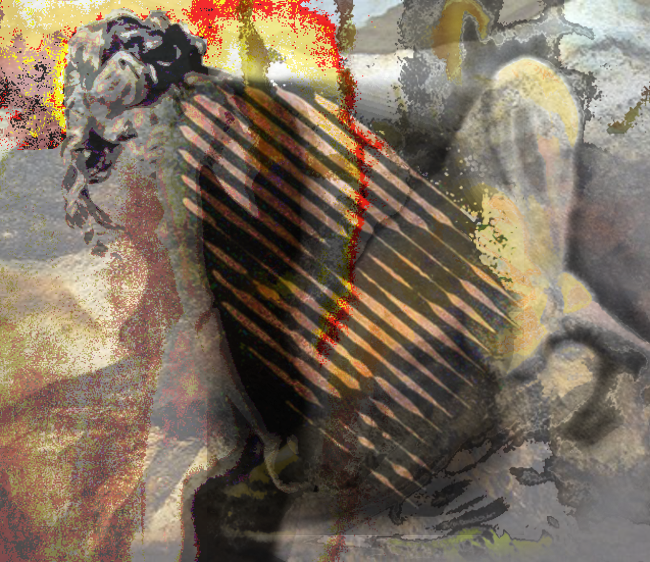
(In most browsers, if you click on the image you can view it in larger format.)
Monday, February 11, 2013
pups rough-housing
Just a little fun, here, to lighten the day...
Sanani and Nikki duking it out, 2 videos:
Sanani and Nikki duking it out, 2 videos:
Sunday, February 10, 2013
Song ov Elmallah, image 1
Last night I completed the following image, to be embedded in an upcoming ebook, The Song ov Elmallahz Kumming, Bouk 1.
The image (below) will accompany the opening stanzas of the poem:
Az if the sunrize
Had not yet begun
And thare on a hill,
Ware the ful moon hung
Entangeld in parcht akkasiyaz,
She muevd, her owtlienz obskure.
Az if thay wer smoke,
Frum a smoldering fiyer
Koiling in kazhewal ternz
Like tendrilz abowt the akkasiya branchez,
Her thots drifted in that wilderness.

Saturday, February 02, 2013
Song ov Elmallahz Kumming: video 2
On 1/31/13 I posted a video for my ebook of Bouk 1 of The Song ov Elmallahz Kumming. Here is a slight revision, with altered text fonts, based on your feedback:
Thursday, January 31, 2013
Song ov Elmallahz Kumming: video
I am preparing an ebook edition of my poem, The Song ov Elmallahz Kumming. Actually, it will be 6 ebooks, one for each book of the poem. The first book is the shortest, about 300 lines or 8 pages. However, the ebook will have both stevetok and normtok versions, audio tracks of the poem in 2-4 stanza clips, a complete reading of the poem, and will include many illustrations and images as well. It will also include at least one video, an impressionistic interpretation of the opening scene of the poem, 28 seconds long (without title and credits, which I'll add later).
Here's the video. Naturally, I would greatly appreciate your critical feedback.
Here's the video. Naturally, I would greatly appreciate your critical feedback.
Sunday, January 27, 2013
Portraits from a wedding
This excerpt from The Atternen Juez Talen is a scene from a marriage celebration from 1000 years ago in North Africa.
Thaerz the bodlen* drapen a suet a rag
* wedding jester
Pachez an nots an haengee strips
Like the ruffel fetherz ov a troppikkel berd.
Him poze, him strut, then poze aggen
Az he mixxen Torrah an bawdee vers,
Shokkenz, an shor az maeks us howl.
Then thaerz the rabbiy loukenz askans,
Him fase as twistee az the Torrah he heer,
With him ekot terben in a brikwerk a shaedz
Ov skarlet an goel, a keenglee krown.
Arrown the tabelz awl pilen a foodz,
The povverish wunz with krustee naelz,
Thaer kallas hanz awl kreest an krakt,
A happallee slerpenz tanjeen and wienz.
An ammungst them, yungsterz grabben sweets,
Thaer cheeks a-bulj an krumz on thaer chin.
An thaer, dansen, like berdz aflok
Divenz an arkenz ov a seengel mien,
Or like skoolz a fish that dart an kerv,
The dansee madenz, aswerrellee skarvz.
An off tu the siedz the kroonen kroenz
With thaer goelden baengelz an hennah hanz,
The koel darkt iyz an silkee shawlz
A-weev in artfule jeyommetreez,
Like the taengellee branchenz a baren treez
Or the win-tos spray in the krash a waev.
An now the reb with krumz on iz chinz,
The yung boy, awl nottee thaer beerdz an grinz.
The kroenz dansen in thaer raggee kloeks.
The madenz a-talen thaer bawdee joeks.
The bodlen sidelz up tu my deer
An kissen her cheek an they dissappeer.
Wednesday, December 05, 2012
The Akedah
The following is a short midrash (literary exploration/expansion) on the biblical story of the Binding of Isaac (Yitzkhak), that is, when Avraham is tested and takes Yitzkhak to sacrifice him. The brief story can be found at Beraysheet/Genesis 22:1-19.
Like so many biblical tales, there is much more left out than told. The text, translated by Fox, says, 22:3, "He saddled his donkey, he took his two serving-lads with him, and Yitzkhak his son..." Of course, the rabbis have been asking, lo these thousand years and more, who are these 2 "serving-lads"? Equally (or more) provocative, the tale says nothing from Yitzkhak's POV, and indeed it concludes with this, 22:19, "Avraham returned to his lads and they arose and went to Be'er-Sheva." Where's Yitzkhak?? These, and many other questions are much commented upon.
One existing midrash suggests that one of the "serving-lads" was none other than Ishmael, Yitzkhak's half brother. Another (unrelated) midrash suggests that Hagar, wife/concubine/servant of Avraham and mother of Ishmael, is an Egyptian. Those 2 little details should provide you with sufficient points of entry into the following:
When Avraham took Yitzkhak, along with Ishmael, a servant, and a donkey up to Mt. Moriah, he said to his Egyptian son, "you stay here with the donkeys, while I take this one up." Then Ishmael cried, "What about me father?! Is there no blessing for me?"
Avraham sternly replied, "Stay with the donkeys."
Avraham and Yitzkhak returned the next day, and Ishmael saw the horror in his brother's eyes. He thought to himself, "This is a God I should fear, and this is a father I should fear. This is a God, better to know from a distance, and this is a father better to keep at a distance."
And they walked back to Be'er-Sheva in silence.
Thursday, November 22, 2012
Response to article in Middle East Star
The Middle East Star, on 11/21 published an article entitled:
Hamas should be engaged by Israel – by Ed Husain
I genuinely believe the author does not consider himself an enemy of Israel, but rather an Arab voice, probably a lonely Arab voice, seeking peace. But like a fish that is unaware of the water in which it swims, the author, in reality, remains a voice of Arab hatred and oppression of Israel and Jews.
The whole article can be found at:
http://www.middleeaststar.com/index.php/postc/210875107/scat/940f2bfd509e743b
Here are some critical excerpts that are revealing of the omnipresent hate driving the Arab (and Muslim) world. After these excerpts (in italics), you can find my response.
... I can name tens of Muslim clerics, important formulators of public opinion in a region dominated by religion, that will readily condemn acts of terrorism against the West, but will fall silent when it comes to condemning Hamas or Islamic Jihad. Put simply, support for violent resistance against Israel among Arab and Muslim-majority countries -- including allies of the United States such as Qatar, Saudi Arabia, Egypt, Turkey, Tunisia -- remains popular.
... From radical Iran to moderate Tunisia, Hamas' Prime Minister Ismail Haniyyeh was welcomed by vast cheering crowds during visits this year.
... Israel needs to change. ... A tiny nation of seven million [Israel; 5.25 million Jews] cannot be allowed to damage ties between 360 million Americans and 300 million Arabs.
Here is my critical response:
As ever, the author, although I don’t doubt that he is well-meaning, has it all backwards. 300 million Arabs and 5 million Jews, but our author says the Jews are the problem, not the Arabs! Why are the Jews a problem? Because they are a minority in a region that only knows oppression of minorities. Ask any Copt, any Kurd, any Assyrian Christian. Indeed, ask any Sunni in a Shia country, or Shiite in a Sunni country!
And of course, it is not Israel that "damages ties between 360 million Americans and 300 million Arabs," as the author would have us believe. It is the hatred, violence, and intolerance of the Arab people, institutionalized by governments, mosques, media, and schools that has damaged ties.
Mr. Husain, YOU are the problem, and you are its clearest symbol. You expose with complete clarity the absolute refusal of the Arab world to look at itself and realize how sick, how immoral, and how dysfunctional it is. Until THAT changes, Israel will be just one more excuse for Arab dysfunction.
Tuesday, November 20, 2012
From The Atternen Juez Talen: Ketuba
In this brief scene the Atternen Ju, who is getting married, watches as his ketuba (marriage contract) is produced by a scribe. The first version is in meta-English, followed by a standard English version. For all you calligraphers and sofers...
Meta-English (Stevetok) version:
...
The skrieb hav a hole jarfule a penz
An a mennee bottellen ov eenks, az wel.
An not a sheet a linnen, starcht,
But rit on a parchmen skind ov a goet!
He puelz owt a goos kwil an kaerfule inspeks;
Sharps it a bit; then a dipt in eenk,
Shaeks it, an taken a long deep breth.
Fliez forth him han, like a swawlo that dievz
An sord thru the aerz, dip an fly,
Dip an fly, an thaer on the parch
A weengen chareb toppen the page.
Then annuther pen in annutherren jar
An annutherren sereez ov shaek an fly.
An wo! the chareb lumen in goel;
An with a flik he a spatterren, starree a sky.
Then, with kaerfule, a mezherren stroek
Larjen letterz in lappis blu,
Youd hay vuv hay*, the holeyes Name
* Hebrew letters, code for ineffable Name;
spoken: Uddoniy
Between the owtstrechen chareb weeng.
Then in a liten a shaden a blu,
El Shuddiy, the nercherres Name
In smawler letter inside Uddoniy.
Now kum the marij kontrak tex,
Awl bizzee an aeree an fule a pomp,
‘Waerfor this’ an ‘waeraz that’
In blak letterren, smawl an skware.
Then zigzag an swerrel tu border the siedz,
An heez dun, we sine, an I’m a mareeyes man.
Standard English (dulltok) version:
...
The scribe has a whole jarful of pens
And many bottles of ink, as well.
And not a sheet of linen, starched,But written on a parchment skin of a goat!
He pulls out a goose quill and carefully inspects;
Sharpens it a bit; then dips it in ink,
Shakes it, and takes a long deep breath.
Flies forth his hand, like a swallow that dives
And soars thru the air, dip and fly,
Dip and fly, and there on the parchment
A winged cherub atop the page.
Then another pen in another jar
And another series of shake and fly.
And whoa! the cherub illumined in gold;
And with a flick he spatters a starry sky.
Then, with careful and measured strokes
Larger letters in lapis blue,
Yud hay vuv hay*, the holiest Name
* Hebrew letters, code for ineffable Name;
spoken: Adonai
Between the outstretched cherub wings.
Then in a lighter shade of blue,
El Shaddai, the nurturing Name
In smaller letters inside Adonai.
Now comes the marriage contract text,
All busy and airy and full of pomp,
‘Wherefore this’ and ‘whereas that’
In black letters, small and square.
Then zigzag and swirl to border the sides,
And he’s done, we sign, and I’m a married man.
Subscribe to:
Posts (Atom)

 Posts


