If you have read any of my poetry, you know I am engaged in a project to transform the language into one that can facilitate a more accurate understanding and description of the world. Existing grammars not only constrain vision and understanding, they distort and tend to polarize reality. Thus my project.
It has had many names. It was first dubbed Stevespell by a friendly critic, at a time when the main thrust was to normalize English spelling. As it evolved and I began to focus on grammar and new modes of thinking and describing, I started calling it Stevetok. But more recently I am inclined to think of it as meta-English, and "standard" English as "old English."
Recently, as I began work on turning Bouk 3 of The Song ov Elmallahz Kumming into an ebook, I discovered that a couple of other authors had worked on the same underlying text, the Sumerian Nin-me-sar-ra text, that lies beneath my Bouk 3. One of those authors is Bill Sigler, who has written a notable re-translation.
We began a conversation, and I sent him links to my poem and some short essays on meta-English. What follows are some comments Bill made, which were very gratifying. I don't think anyone else has understood so clearly what I'm doing:
I appreciate the hat tip on your lucid yet wide-ranging linguistics
pieces. The poetics are intriguing, the idealism familiar. ... Still, call me weird, but I think "Blak Fiyer on Jennettek Fiyer"
explicates the whole thing so beautifully and perfectly, without trying
to patiently shine the pearls in the swine's ass. Your essays call to
mind a more sober Finnegan's Wake, but your poems are something else
entirely, like those filters that turn music into pure sound and break
up the hegemony of melody and harmony. In other words, because word
meanings are so intangible, the implications need to enigmatized for the
sake of the holy transportation away from mind into spirit through the
word. Few have been called for such work, fewer are chosen. I for one
honor that you've created and maintained this reality in the face of
Blakean odds. It does not need more justification, in my view, only more
time ( from me and others). I haven't had much chance to delve in much
yet, but nothing I've seen yet would discourage that. I will get to it
in my own way, and will undoubtedly report back. For now I'll just say
the Sumerian tree of life is on the edges of our existence, waiting to
be found...
Thanks Bill! You can find Bill's poetry and ideas at:
http://billsigler.blogspot.com/ and other sites (check his profile).
His translations of the Nin-me-sar-ra are at:
http://billsigler.blogspot.com/search?q=Nin-me-sar-ra
Showing posts with label poetics. Show all posts
Showing posts with label poetics. Show all posts
Sunday, February 23, 2014


Tuesday, August 27, 2013
Introduction to Elmallah 2
Here's the introduction that opens Bouk 2 of The Song ov Elmallahz Kumming. I call it a "belated" introduction because it stands at the beginning of Bouk 2 rather than Bouk 1.
A Belated Introduction:
This poem originated in a series of 9 poems I wrote in 1976 to a woman who was to become my wife. At that time I assumed, unrealistically, that the underlying mythic and psychologic levels in those poems would be known and understood by the reader. I was unrealistic not only because those 9 short poems implied and made reference to far more than what was stated, but because the mythic and spiritual levels I was referring to were hardly even thought about by most 20th century poetry readers.
Coming to realize this, I have expanded that short series into this narrative in six books. It attempts to lay out some of the mythic foundations of our consciousness. Many of the images briefly glossed in this book will be transposed and transisted into other scenes in other parts of the poem. At the same time, images of what is yet to come will echo in these opening scenes. In the Prophetic Conscience, past, present, and future are intertwined.
Concerning Bouk 2: for Ertha it is set in a prehistoric moment, a timeless period from which she is emerging, as she experiences a glorious expansion of her consciousness. Elmallah, diffracted into that history, and giving its evolution direction, tries to reach to her and still hold on to the Divine Moment. Tho confined in her time, his mind is not so confined. Living beyond the photon boundary that shapes space in a closed sphere, dwelling in the axis of infinite time where all things exist in infinite multiplicity and all paths are parallel and non coherent, from that awareness he communicates with Ertha. Thought flows between them, visible to Elmallah, palpable to all his senses. His infinite bodies intersect her infinite bodies. He touches her. His infinitely repeating hand reaches between her infinitely mirrored legs, there where his eyes were originally drawn, to that dark moist center in her being. His arid Conscience is interleaved in a hyper-globe of pleasure, and then desire for pleasure, and then dependence on pleasure, and then despondence over his dependence.
Elmallah is astonished by their sexual crescendo. He feels it like a vast surf washing up on the sand. It is Ertha's Conscience washed by his Knowledge, followed by her perpetual forgetting. It is his energy penetrating her levels and withdrawing. It rushes - surf - he tells her of the Lor; withdraws - surf - she hears and recreates it in her Conscience. It rushes - surf - he sees how she has distorted his Knowledge; withdraws - surf - into his despair; rushes - surf - he touches her differently and new awarenesses emerge; ebb and flow while making love. The scene ends. For a moment Ertha glimpses a vision of the Lor - surf - is thunderstruck - surf - sees now the pantheon of Babylon standing above - surf - forgets that too - surf - remembers only that she has seen something awesome that she can't hold, can't comprehend.
Ertha's history with Elmallah is not a continuous series of events, but layered states, stratified in Their Conscience.
A Belated Introduction:
This poem originated in a series of 9 poems I wrote in 1976 to a woman who was to become my wife. At that time I assumed, unrealistically, that the underlying mythic and psychologic levels in those poems would be known and understood by the reader. I was unrealistic not only because those 9 short poems implied and made reference to far more than what was stated, but because the mythic and spiritual levels I was referring to were hardly even thought about by most 20th century poetry readers.
Coming to realize this, I have expanded that short series into this narrative in six books. It attempts to lay out some of the mythic foundations of our consciousness. Many of the images briefly glossed in this book will be transposed and transisted into other scenes in other parts of the poem. At the same time, images of what is yet to come will echo in these opening scenes. In the Prophetic Conscience, past, present, and future are intertwined.
Concerning Bouk 2: for Ertha it is set in a prehistoric moment, a timeless period from which she is emerging, as she experiences a glorious expansion of her consciousness. Elmallah, diffracted into that history, and giving its evolution direction, tries to reach to her and still hold on to the Divine Moment. Tho confined in her time, his mind is not so confined. Living beyond the photon boundary that shapes space in a closed sphere, dwelling in the axis of infinite time where all things exist in infinite multiplicity and all paths are parallel and non coherent, from that awareness he communicates with Ertha. Thought flows between them, visible to Elmallah, palpable to all his senses. His infinite bodies intersect her infinite bodies. He touches her. His infinitely repeating hand reaches between her infinitely mirrored legs, there where his eyes were originally drawn, to that dark moist center in her being. His arid Conscience is interleaved in a hyper-globe of pleasure, and then desire for pleasure, and then dependence on pleasure, and then despondence over his dependence.
Elmallah is astonished by their sexual crescendo. He feels it like a vast surf washing up on the sand. It is Ertha's Conscience washed by his Knowledge, followed by her perpetual forgetting. It is his energy penetrating her levels and withdrawing. It rushes - surf - he tells her of the Lor; withdraws - surf - she hears and recreates it in her Conscience. It rushes - surf - he sees how she has distorted his Knowledge; withdraws - surf - into his despair; rushes - surf - he touches her differently and new awarenesses emerge; ebb and flow while making love. The scene ends. For a moment Ertha glimpses a vision of the Lor - surf - is thunderstruck - surf - sees now the pantheon of Babylon standing above - surf - forgets that too - surf - remembers only that she has seen something awesome that she can't hold, can't comprehend.
Ertha's history with Elmallah is not a continuous series of events, but layered states, stratified in Their Conscience.
Thursday, March 14, 2013
Arrownd her klay silluwet
As I was reworking the image last night, Nancy looked into my study, so I asked her what she thought of the new version. She didn’t like it. Undecipherable and lacking visual coherence. Well, Blake was right, corporeal friends are spiritual enemies (and vice versa). In this case, acting as my spiritual friend, my wife didn’t withhold her bad news. And, being my own spiritual friend, her comments made sense.
Part of the problem is that superimposing images is a process, and the process gets lost in the reduction to a final version, a single image. I thought of that life-changing experience I had, walking the beach in Provincetown lifetimes ago, in which the whole trek from MacMillan wharf to my cottage sandwiched between the Penny Farthing and the Green Monster, a 25 minute walk, took place in a single instant. No, I didn’t take one giant step, boom, and I was home. And no, I didn’t slip thru a wormhole (best as I can figure). Rather, my sense of time dilated. I knew every single thing that would happen on that 25 minute walk, every person I’d see, every detail I’d experience. But in that dilated moment, nothing seemed strange to me. It was simply a moment like any other. It was only after I got home, saw where I was, came back to my “normal” sense of time and understood what happened, that I fell smack-down in utter astonishment, looked up at the starry sky, and tried to figure out what just happened.
So, folks, here’s an opportunity for you to experience a dilated moment. I’ve taken my “instantaneous image”, and dilated it into a 42 second image, including some periodic voice-over coupled with overlaid text. Now, this experience won’t necessarily help you to like my aesthetics, but I hope it will help you understand and appreciate the image, and a bit of the poem that the image is meant to illustrate. And maybe, it will even give you a taste of one kind of mystical experience, dilated time, so that you can experience directly how limited our consciousness is, and how much more is possible and even/almost within our grasp.
You can also view the video in slightly higher resolution at
http://youtu.be/gQKxZbtauVw
Friday, February 15, 2013
Song of Elmallah, image 2
I continue to develop the images to illustrate Bouk 1 of The Song ov Elmallahz Kumming. Below is the second image, but first, perhaps these brief technical notes will help the reader/viewer understand a little better what I’m trying to do.
My poetry is highly layered, like a painting that uses multiple thin layers of translucent color to build up depth and accuracy of image. Our “seeing” of the world, in the same way, is a complex interpretive event, that lays narrative and value into sensory inputs. Our senses are not clear windows on “reality”. They are lenses with a large, mostly unconscious set of filters, in place at the outset by a synapsed nervous system, and then built up thru layers of mind (a crude list): emotions, needs, intellect, experience, conscience, soul/spirit (a vague term because our tools are weakest here).
I try to diffract and expose some of this thru my images, both textual and visual. In the visual image below, the abstract “background” is the chaos, the tohu and vohu, the perspective-less consciousness out of which we create narrative. In this image we discern three women, and with the poem as background, we can construct a tenuous narrative out of the atomized and incoherent ground in which they are embedded.
The image below, entitled Arrownd Her Klay Silluwet, accompanies the following lines that can be found in the early part of the poem, when Elmallah (an angel descending from the upper genomes) first encounters Ertha:
I ternd awway
But agen loukt bak.
Wen Lots wife loukt bak
Tu the Soddem that she fled,
Her Sol kristeld in salt.
Wen Polladekteez ternd frum revvelree
Tu reseev hiz gift,
Proteyus held the hed ov Meddusa
And froze him intu stone.
Wen Eddippus ternd and staggerd
Frum the bed ware he
And hiz muther had lain,
He gowjd hiz eyz with redhot pinz.
Wen I loukt bak
Her tangeld hare wuz kut and koemd;
Her hed wuz bownd in kloth.
Her hips, her legz, her kumlee brests
Wer titelee rapt in dust-brown muzlin.
Akros her fase emotenz rippeld
Like wind akros the surfas ov a bay.
But arrownd her klay silluwet:
A korrona, like the Sol in eeklips.

(In most browsers, if you click on the image you can view it in larger format.)
My poetry is highly layered, like a painting that uses multiple thin layers of translucent color to build up depth and accuracy of image. Our “seeing” of the world, in the same way, is a complex interpretive event, that lays narrative and value into sensory inputs. Our senses are not clear windows on “reality”. They are lenses with a large, mostly unconscious set of filters, in place at the outset by a synapsed nervous system, and then built up thru layers of mind (a crude list): emotions, needs, intellect, experience, conscience, soul/spirit (a vague term because our tools are weakest here).
I try to diffract and expose some of this thru my images, both textual and visual. In the visual image below, the abstract “background” is the chaos, the tohu and vohu, the perspective-less consciousness out of which we create narrative. In this image we discern three women, and with the poem as background, we can construct a tenuous narrative out of the atomized and incoherent ground in which they are embedded.
The image below, entitled Arrownd Her Klay Silluwet, accompanies the following lines that can be found in the early part of the poem, when Elmallah (an angel descending from the upper genomes) first encounters Ertha:
I ternd awway
But agen loukt bak.
Wen Lots wife loukt bak
Tu the Soddem that she fled,
Her Sol kristeld in salt.
Wen Polladekteez ternd frum revvelree
Tu reseev hiz gift,
Proteyus held the hed ov Meddusa
And froze him intu stone.
Wen Eddippus ternd and staggerd
Frum the bed ware he
And hiz muther had lain,
He gowjd hiz eyz with redhot pinz.
Wen I loukt bak
Her tangeld hare wuz kut and koemd;
Her hed wuz bownd in kloth.
Her hips, her legz, her kumlee brests
Wer titelee rapt in dust-brown muzlin.
Akros her fase emotenz rippeld
Like wind akros the surfas ov a bay.
But arrownd her klay silluwet:
A korrona, like the Sol in eeklips.
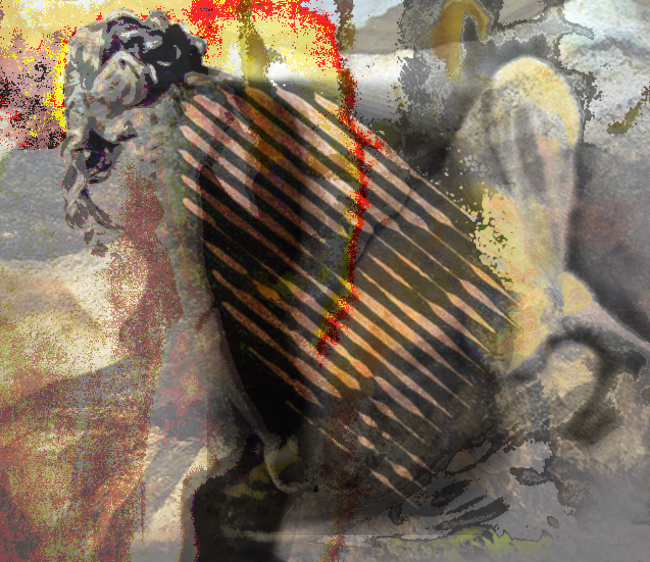
(In most browsers, if you click on the image you can view it in larger format.)
Monday, April 02, 2012
multi-threaded nature of thought
My reading, reflecting my interests, spans a wide range of topics. However, the subject of thought – what it is and how we experience it - is almost entirely unexplored (with the exception of some lame and poorly written philosophical treatises on "mind"). It appears that, in large measure, most people think of "a thought" as a distinct, precise, and unalloyed unit, not unlike the idea of the "atom" as imagined in the late 19th century.
That late 19th century "atom", it turned out, is not the ultimate building block of matter, and indeed will probably end up being seen as a fictional unit altogether, discarded from scientific discourse. So too, it is becoming clear that our thoughts are not singular, fundamental units of consciousness, but are complex fabrics woven of many strands and fragments. Or to use another analogy, our thoughts are like symphonic compositions, with multiple instruments playing independent but related, or semi-related consonant and dissonant melodies, tones, and percussive beats.
This understanding of thought is derived from my direct experience, and emerges from the comprehensively documented observations of the highly superimposed nature of consciousness. To use a computing metaphor, human consciousness is a multi-tasking system, and each task is multi-threaded. At any given moment, consciousness is composed of multiple sensations, emotions, thoughts, and higher-order impressions and operations (these latter being beyond the threshold of common awareness), and each sensation, emotion, and thought is multi-threaded.
Most of the time most people are entirely unaware of this symphony of processing going on within them, that comprises human mentation. Indeed, we are wont to reduce this welter of processes to single thoughts, or single emotions, or single sensations, or at most, single (mostly) linear narratives. The arts, of course, challenge this kind of simplification. As noted, the symphony with its multiple instruments playing multiple melodies, phrases, and sounds replicates the multi-threaded nature of human consciousness. The novel, with its complex interacting characters and interwoven story lines replicates both the multi-tasking and multi-threading of consciousness. Yet, nowhere in literature, at least to my knowledge, has this exploration of complexity focused down into the multi-threaded functioning of consciousness itself. At most, we have stream-of-consciousness techniques exploring the uppermost level of awareness and its often non-linear narrative trajectory.
That late 19th century "atom", it turned out, is not the ultimate building block of matter, and indeed will probably end up being seen as a fictional unit altogether, discarded from scientific discourse. So too, it is becoming clear that our thoughts are not singular, fundamental units of consciousness, but are complex fabrics woven of many strands and fragments. Or to use another analogy, our thoughts are like symphonic compositions, with multiple instruments playing independent but related, or semi-related consonant and dissonant melodies, tones, and percussive beats.
This understanding of thought is derived from my direct experience, and emerges from the comprehensively documented observations of the highly superimposed nature of consciousness. To use a computing metaphor, human consciousness is a multi-tasking system, and each task is multi-threaded. At any given moment, consciousness is composed of multiple sensations, emotions, thoughts, and higher-order impressions and operations (these latter being beyond the threshold of common awareness), and each sensation, emotion, and thought is multi-threaded.
Most of the time most people are entirely unaware of this symphony of processing going on within them, that comprises human mentation. Indeed, we are wont to reduce this welter of processes to single thoughts, or single emotions, or single sensations, or at most, single (mostly) linear narratives. The arts, of course, challenge this kind of simplification. As noted, the symphony with its multiple instruments playing multiple melodies, phrases, and sounds replicates the multi-threaded nature of human consciousness. The novel, with its complex interacting characters and interwoven story lines replicates both the multi-tasking and multi-threading of consciousness. Yet, nowhere in literature, at least to my knowledge, has this exploration of complexity focused down into the multi-threaded functioning of consciousness itself. At most, we have stream-of-consciousness techniques exploring the uppermost level of awareness and its often non-linear narrative trajectory.
Having introspectively explored my thinking processes for over 40 years, it seems appropriate (perhaps long overdue) that I now take my perspective down into the multiple threads of thought to try to unpack them. Perhaps the subject may seem more appropriate for a psychological essay or a phenomenological tract. But those forms lack both aesthetic richness and narrative ordering principles, and aesthetics and narrative are core components of consciousness. Therefore I am exploring these horizons of consciousness through a poetic lens, hoping, through a sort of stop-frame process, to expose a more accurate and nuanced representation of human mentation.
In my next post will you will be able to read (and critique) a first draft of just such an exploration.
Wednesday, November 02, 2011
My writing career, briefly
My writing career spans forty years. From one perspective I am developing a Jewish and kabbalistic vision of the world, the mind, and the soul. From another perspective, I am composing long narrative poems that explore the clash between the real and the ideal, in the lives of historical figures and people I have known. From yet a third perspective, I am developing a new, more versatile language in which the complexity and multi-dimensionality of quantum mechanics is carved into the lens of language itself.
Or let me put it this way: I have spent the last 40 years writing poetry that re-visions and re-models not just the world we live in, but the language with which we see, describe, and understand that world. In the process I have created a new grammar to represent the fundamental indeterminacies at the horizons of thought. This has been a slow process requiring much persistence, not only because of its own inherent difficulties, but because of the difficulties it creates for readers, who have a challenging enough job deciphering the experiments and non-linearities of modern and post-modern writing. The result, though a challenge to many readers, allows my work to achieve layered and faceted perspectives that a traditional use of language inherently prohibits.
It seems that I am almost alone in spearheading the development of a language that can reflect and express the nature of quantum mechanics, both in physics and in consciousness. But I am not entirely alone. In 1980 David Bohm, the renowned physicist, published his last book, Wholeness and the Implicate Order. It is about the need to develop a new language in response to quantum mechanics! In 1980 I was already six years into my project to recreate English.
Or let me put it this way: I have spent the last 40 years writing poetry that re-visions and re-models not just the world we live in, but the language with which we see, describe, and understand that world. In the process I have created a new grammar to represent the fundamental indeterminacies at the horizons of thought. This has been a slow process requiring much persistence, not only because of its own inherent difficulties, but because of the difficulties it creates for readers, who have a challenging enough job deciphering the experiments and non-linearities of modern and post-modern writing. The result, though a challenge to many readers, allows my work to achieve layered and faceted perspectives that a traditional use of language inherently prohibits.
It seems that I am almost alone in spearheading the development of a language that can reflect and express the nature of quantum mechanics, both in physics and in consciousness. But I am not entirely alone. In 1980 David Bohm, the renowned physicist, published his last book, Wholeness and the Implicate Order. It is about the need to develop a new language in response to quantum mechanics! In 1980 I was already six years into my project to recreate English.
Saturday, October 15, 2011
Contra Eliot and Pound, 2
On August 15, 2008 I posted a response to some comments related to my poem Europa, Europa. I entitled that response "Contra Eliot and Pound", in which I condemned both authors, but especially Eliot for their anti-Semitism. That article can be found at:
Of the many things I didn't mention in that article was the poem by Emanuel Litvinoff, To T. S. Eliot, in which he takes Eliot to task for his anti-Semitism. Litvinoff died in early October of this year, and the New York Times published an article, eulogizing him. However, the article primarily focused on his poem To T. S. Eliot, and his criticism of Eliot. Here's a link to the article, and following the link, a few noteworthy excerpts from it:
The article begins:
Emanuel Litvinoff, an English-born Jewish poet known for his scathing verse indictment of T. S. Eliot’s anti-Semitism — and for reading it before an audience that happened to include Eliot — died on Sept. 24 at his home in London. He was 96. ...
But it was for his poem “To T. S. Eliot” that he was best remembered. Written after World War II and widely anthologized, it was a response to work by Eliot that contained unapologetic anti-Semitic elements. One such poem, “Burbank With a Baedeker: Bleistein With a Cigar,”...
This poem (Burbank ...) was first published in 1920. Before World War II, Mr. Litvinoff, who otherwise admired Eliot’s work, was prepared to dismiss it as simply another link in the venerable chain of British literary anti-Semitism.
Eliot chose to reprint the poem in his anthology “Selected Poems,” published in 1948. That, in the post-Holocaust world, struck Mr. Litvinoff as inexcusable. ...In early 1951, Mr. Litvinoff was invited to take part in an illustrious public poetry reading at the Institute of Contemporary Arts in London. He brought the poem with him.
He had no idea, though, that just before he began reading it aloud, its subject would walk through the door. ...
By the time it was Mr. Litvinoff’s turn to read, he said afterward, he was keenly aware that the target of the corrosive lines he was about to utter was sitting in the audience. ...
There was, however, a dissenting voice. Amid the tumult, a man in the back of the room was heard to mutter: “It’s a good poem. It’s a very good poem.”
The speaker was Thomas Stearns Eliot.
More on that public reading can be found by clicking the links in the excerpts above, at least one of which will take you here:
Saturday, May 22, 2010
The Architectonics of Poetry
sketched 5/9/2010
descending Bright Angel Trail, Grand Canyon
As Cal and I began our hike down the Bright Angel Trail, it struck me, overlooking the Canyon, that here, in the presence of time-defiant carvings, vaster, more slowly and minutely sculpted than any imaginable human endeavor, that in this scene of staggering contrasts, one may postulate and reflect upon the most significant distinction between American and European culture.
I will speak specifically of poetry.
In broad strokes, we may say that Europe has inherited and developed highly structured, metered, rhymed, and decorative forms of poetic expression. The many forms this has taken yet reflect a unifying, underlying purpose: that the human enterprise is about managing and controlling nature. It is a poetry of architectonics, asserting the human rejection of randomness, insignificance, minuteness. Even where, in this body of work, the human enterprise, personally or on a grand scale pales or fails, still, the divine and especially the messianic is tangent and prepared to assume authority. Yes, that is it: the structuring of European poetry represents a literature of an authoritarian human will conquering nature, and where that fails, of divine interventions that either shape or crush us.
Not so the quintessential American poetry, vis, Whitman, Neihardt, Jeffers, Turner, Thoreau (as if prose poetry), and their intellectual and spiritual colleagues in Bierstadt, Moran, Cole, Remington. The architectonics of their art are not driven by or contained in the formalities of fixed structures. Their vision is an outpouring of an epic narrative, following the non-linear and unexpected contours of consciousness, and emulating nature, rather than trying to control, restructure, or geometricize it. Natural beauty and natural structure are the virtue of this art and its vision, and the divine is not tangent or removed or above, nor waiting to intervene with redemptions and punishments, but embedded and present, immanent. And as the divine is immanent, so is the human responsibility to moral action, here, now, not deferred, not waiting for a messiah, but acting with a messianic agency.
Thus my meandering thoughts as we climb down the steep trail that follows native contours, crossing paths with speakers of a dozen languages or more, the California Condor brooding silently overhead, cliffs and steep drops but a step or two away, awestruck and inspired, thinking of this conflicted, flawed, and glorious nation and the unexpected changes it has generated in the human soul, in the human word.
descending Bright Angel Trail, Grand Canyon
As Cal and I began our hike down the Bright Angel Trail, it struck me, overlooking the Canyon, that here, in the presence of time-defiant carvings, vaster, more slowly and minutely sculpted than any imaginable human endeavor, that in this scene of staggering contrasts, one may postulate and reflect upon the most significant distinction between American and European culture.
I will speak specifically of poetry.
In broad strokes, we may say that Europe has inherited and developed highly structured, metered, rhymed, and decorative forms of poetic expression. The many forms this has taken yet reflect a unifying, underlying purpose: that the human enterprise is about managing and controlling nature. It is a poetry of architectonics, asserting the human rejection of randomness, insignificance, minuteness. Even where, in this body of work, the human enterprise, personally or on a grand scale pales or fails, still, the divine and especially the messianic is tangent and prepared to assume authority. Yes, that is it: the structuring of European poetry represents a literature of an authoritarian human will conquering nature, and where that fails, of divine interventions that either shape or crush us.
Not so the quintessential American poetry, vis, Whitman, Neihardt, Jeffers, Turner, Thoreau (as if prose poetry), and their intellectual and spiritual colleagues in Bierstadt, Moran, Cole, Remington. The architectonics of their art are not driven by or contained in the formalities of fixed structures. Their vision is an outpouring of an epic narrative, following the non-linear and unexpected contours of consciousness, and emulating nature, rather than trying to control, restructure, or geometricize it. Natural beauty and natural structure are the virtue of this art and its vision, and the divine is not tangent or removed or above, nor waiting to intervene with redemptions and punishments, but embedded and present, immanent. And as the divine is immanent, so is the human responsibility to moral action, here, now, not deferred, not waiting for a messiah, but acting with a messianic agency.
Thus my meandering thoughts as we climb down the steep trail that follows native contours, crossing paths with speakers of a dozen languages or more, the California Condor brooding silently overhead, cliffs and steep drops but a step or two away, awestruck and inspired, thinking of this conflicted, flawed, and glorious nation and the unexpected changes it has generated in the human soul, in the human word.
Saturday, February 27, 2010
Rethinking Grammar
I was sitting on the bus going to work, annotating George K. Anderson's The Legend of the Wandering Jew. My mind drifted away from the text, to my act of annotation, and from there to the grammatical form of the word “annotation.” It's a simple word, a noun. And of course, a noun is a person, place, thing, state, or quality; or more fully, as most dictionaries will remind you, the subject or object of a sentence that can be modified into plural and possessive. But that definition hardly begins to describe the grammatical function that the word “annotation” implies.
Consider. It's root is “note”, , which can be either a noun or a verb, but in this case I'll call it a noun. However, by adding the prefix “an-” it is transformed into a verb, which is thence retransformed back into a noun with the suffix “-tion”! Those ambiguities and transformations all are processed instantly by our minds, and are equally instantly ignored as we read a sentence with the word “annotation” in it.
Now, I ask you, is “annotation” a noun, and if so, what is a noun?!
The more I explore stevespell, the more I realize that the apparently strange and foreign grammars and constructions embedded in it, such as noun-verbs like “annotaten”, are neither strange nor foreign. We simply choose to ignore the complexity that already exists in the language. In actuality, like the quantum mechanical electron, our words are constantly changing forms and states, and we are hard-pressed to know when they're particles and when they're waves and when they're something else entirely.
Of course, back here in the real world, my 7th grade English teacher, Mrs. Newton, will wag her crooked finger in my face and scold me with nary a second thought, “I'll have none of that, young man! A noun is a noun, and you better be able to diagram it correctly on the next test, or you'll be back in the corner sitting by yourself again!”
Another thing Mrs. Newton doesn't know: I like sitting by myself.
Consider. It's root is “note”, , which can be either a noun or a verb, but in this case I'll call it a noun. However, by adding the prefix “an-” it is transformed into a verb, which is thence retransformed back into a noun with the suffix “-tion”! Those ambiguities and transformations all are processed instantly by our minds, and are equally instantly ignored as we read a sentence with the word “annotation” in it.
Now, I ask you, is “annotation” a noun, and if so, what is a noun?!
The more I explore stevespell, the more I realize that the apparently strange and foreign grammars and constructions embedded in it, such as noun-verbs like “annotaten”, are neither strange nor foreign. We simply choose to ignore the complexity that already exists in the language. In actuality, like the quantum mechanical electron, our words are constantly changing forms and states, and we are hard-pressed to know when they're particles and when they're waves and when they're something else entirely.
Of course, back here in the real world, my 7th grade English teacher, Mrs. Newton, will wag her crooked finger in my face and scold me with nary a second thought, “I'll have none of that, young man! A noun is a noun, and you better be able to diagram it correctly on the next test, or you'll be back in the corner sitting by yourself again!”
Another thing Mrs. Newton doesn't know: I like sitting by myself.
Sunday, February 14, 2010
Quantum Mechanics and Language
Upon reading David Bohm's Wholeness and the Implicate Order.
From the first paragraph of Bohm's introduction to Wholeness and the Implicate Order, I realized that what he was theorizing about in this book, published in 1980, I was concurrently developing in my poetry since the mid 70's. You can find many of my short essays on language and consciousness on this blog or at my website, shivvetee.com. If you are unfamiliar with my thoughts on this topic, I suggest you begin with a pleasant and easy little essay, “Wy I Rite So Funnee” at:
Wy I Rite So Funnee
If you want to then go deeper, you can explore some of the labels on this blog, such as 'complexity,' 'phenomenology,' and 'poetics,' or you can jump right to this link which is a partial summary of my various posts:
Literary Complexity
Bohm's path emerged from quantum mechanics; mine from phenomenology and consciousness, but both of us realized the necessity of interdisciplinary analysis. My ideas have been greatly influenced by the development of quantum mechanics over the 20th century, as Bohm's have been by phenomenology and the philosophy of consciousness.
Consider this statement by Bohm, who is widely regarded one of the Illuminati of quantum mechanics:
"It is clear that in reflecting on and pondering the nature of movement, both in thought and in the object of thought, one comes inevitably to the question of wholeness or totality. The notion that the one who thinks (the Ego) is at least in principle completely separate from and independent of the reality that he thinks about is of course firmly embedded in our entire tradition.... But this confronts us with a very difficult challenge: How are we to think coherently of a single, unbroken, flowing actuality of existence as a whole, containing both thought (consciousness) and external reality as we experience it?" (Bohm, p. x of Introduction, 1981 paperback, Routledge, Kegan, Paul Ltd.)
He then goes on two pages later:
"In chapter 2 we go into the role of language in bringing about fragmentation of thought.... We then inquire whether it is possible to experiment with new language forms in which the basic role will be given to the verb rather than the noun. Such forms will have as their content a series of actions that flow and merge into each other, without sharp separations or breaks." (ibid, p. xii)
Now consider this excerpt from my mid-80's essay, “Wy I Rite so Funnee”:
"My second intention with stevespell was more ambitious and radical. I wanted to develop a grammar in which subject and predicate, object and action were merged. I had heard that this was possible in Sanskrit, and it seemed intuitively right to me. Surely, the actor and the action are not two separate things, but aspects of one thing.... Perhaps our language was creating unnatural distinctions between actor and action, or between past, present, and future."
In chapter 1, p. 9, Bohm explores his first love, quantum mechanics.
"In a more detailed description the atom is, in many ways, seen to behave as much like a wave as a particle. It can perhaps best be regarded as a poorly defined cloud, dependent for its particular form on the whole environment, including the observing instruments. Thus, one can no longer maintain the division between the observer and observed (which is implicit in the atomistic view that regards each of these as separate aggregates of atoms)."
Here we see the confluence of quantum mechanics and consciousness in two important areas.
First, Bohm, working from Heisenberg, says that, in atomic spaces, the act of observation affects what is observed. We see this in precisely the same way phenomenologically. The act of self observation modifies what is observed (our thoughts). The closer we observe ourselves, the more completely our act of observation is what we see, obscuring and obstructing a free flow of thought. This is a precise corollary to Heisenberg's principle that when we observe phenomena at the atomic level, the more accurately we desire to know where a given object is, the more inaccurate our understanding of where it is going.
Second, just as at atomic level observation we see the breakdown of the “division between the observer and observed,” so we see in consciousness that there is no clear division between individuals. This is quite obvious by observing the transmission of emotion from one person to another. An individual shouting angrily at another causes an immediate and visceral reaction, usually either anger or fear in like measure. This transmission is not based on proximity, and can be verbal or non-verbal. Two people shouting at each other will each become increasingly disturbed, while an onlooker, to whom their anger is not directed, can observe dispassionately. I have also often observed in myself, when sitting silently with someone who is extremely anxious, that although I am not consciously aware of their anxiety, I will find myself inexplicably anxious, inexplicable, that is, until I ask them, “are you anxious or nervous?” Their answer almost always confirms that what I am feeling is their emotion!
I will offer one more example of the confluence between quantum mechanics and consciousness using Bohm's observations as a starting point. On pp. 9-10 he says:
"What is needed in a relativistic theory is to give up altogether the notion that the world is constituted of basic objects or 'building blocks.' Rather, one has to view the world in terms of universal flux of events and processes. Thus,... instead of thinking of a particle, one is to think of a 'world tube.'
This world tube represents an infinitely complex process of a structure in movement and development which is centred in a region indicated by the boundaries of the tube. However, even outside the tube, each 'particle' has a field that extends through space and merges with the fields of other particles."
Let me now rewrite the second paragraph, speaking of human beings rather than atomic particles:
"This human body represents an infinitely complex process of a structure in movement and development which is centred in a region indicated by the boundaries of the body. However, even outside the body, each 'ego' has a field that extends through space and merges with the fields of other egos."
These overlapping fields are not limited to atomic and subatomic particles and emotional sensitivities. I would posit that the very nature of consciousness is represented better by behaviors described by quantum mechanics than by any Euclidean or Newtonian model. Therefore, time, also must be understood in a quantum mechanical way, since time is a product of consciousness. While the ego is focused into a present moment, that looks back into a past and forward to a future, human consciousness itself is not so bounded. Events of the past can have a profound effect on present behavior without there being any direct series of causal connections. Consciousness connects past, present, and future into a single interactive continuum with multiple, direct causalities.
Our language is structured to make concrete distinctions between objects, between objects and the actions that connect them, and between moments in time. These distinctions can be a helpful artifice, but they misrepresent the true behavior of objects in motion (events in time), and thought (consciousness). Bohm postulates a more active, fluid, verb-based language, but that is insufficient. Stevespell attempts a more comprehensive interleaving of objects, events, and time periods. I would call it a quantum mechanical language, which attempts to represent the more complex, non-Euclidean, interactive causalities operating in the human observation of the mental and physical worlds.
In sum, as we begin to peer into the atomic world, where matter “sublimates” into energy and energy “condenses” into matter, we are also observing the workings of consciousness as it articulates the foundations of space-time. This more accurate observational ability that evolved in the 20th century, shattered our ancient world-views (Aristotelian, Euclidean, Newtonian). Now we are beginning to understand that our further development is inhibited by our language, which also needs to evolve to represent this new, subtler understanding of our world.
From the first paragraph of Bohm's introduction to Wholeness and the Implicate Order, I realized that what he was theorizing about in this book, published in 1980, I was concurrently developing in my poetry since the mid 70's. You can find many of my short essays on language and consciousness on this blog or at my website, shivvetee.com. If you are unfamiliar with my thoughts on this topic, I suggest you begin with a pleasant and easy little essay, “Wy I Rite So Funnee” at:
Wy I Rite So Funnee
If you want to then go deeper, you can explore some of the labels on this blog, such as 'complexity,' 'phenomenology,' and 'poetics,' or you can jump right to this link which is a partial summary of my various posts:
Literary Complexity
Bohm's path emerged from quantum mechanics; mine from phenomenology and consciousness, but both of us realized the necessity of interdisciplinary analysis. My ideas have been greatly influenced by the development of quantum mechanics over the 20th century, as Bohm's have been by phenomenology and the philosophy of consciousness.
Consider this statement by Bohm, who is widely regarded one of the Illuminati of quantum mechanics:
"It is clear that in reflecting on and pondering the nature of movement, both in thought and in the object of thought, one comes inevitably to the question of wholeness or totality. The notion that the one who thinks (the Ego) is at least in principle completely separate from and independent of the reality that he thinks about is of course firmly embedded in our entire tradition.... But this confronts us with a very difficult challenge: How are we to think coherently of a single, unbroken, flowing actuality of existence as a whole, containing both thought (consciousness) and external reality as we experience it?" (Bohm, p. x of Introduction, 1981 paperback, Routledge, Kegan, Paul Ltd.)
He then goes on two pages later:
"In chapter 2 we go into the role of language in bringing about fragmentation of thought.... We then inquire whether it is possible to experiment with new language forms in which the basic role will be given to the verb rather than the noun. Such forms will have as their content a series of actions that flow and merge into each other, without sharp separations or breaks." (ibid, p. xii)
Now consider this excerpt from my mid-80's essay, “Wy I Rite so Funnee”:
"My second intention with stevespell was more ambitious and radical. I wanted to develop a grammar in which subject and predicate, object and action were merged. I had heard that this was possible in Sanskrit, and it seemed intuitively right to me. Surely, the actor and the action are not two separate things, but aspects of one thing.... Perhaps our language was creating unnatural distinctions between actor and action, or between past, present, and future."
In chapter 1, p. 9, Bohm explores his first love, quantum mechanics.
"In a more detailed description the atom is, in many ways, seen to behave as much like a wave as a particle. It can perhaps best be regarded as a poorly defined cloud, dependent for its particular form on the whole environment, including the observing instruments. Thus, one can no longer maintain the division between the observer and observed (which is implicit in the atomistic view that regards each of these as separate aggregates of atoms)."
Here we see the confluence of quantum mechanics and consciousness in two important areas.
First, Bohm, working from Heisenberg, says that, in atomic spaces, the act of observation affects what is observed. We see this in precisely the same way phenomenologically. The act of self observation modifies what is observed (our thoughts). The closer we observe ourselves, the more completely our act of observation is what we see, obscuring and obstructing a free flow of thought. This is a precise corollary to Heisenberg's principle that when we observe phenomena at the atomic level, the more accurately we desire to know where a given object is, the more inaccurate our understanding of where it is going.
Second, just as at atomic level observation we see the breakdown of the “division between the observer and observed,” so we see in consciousness that there is no clear division between individuals. This is quite obvious by observing the transmission of emotion from one person to another. An individual shouting angrily at another causes an immediate and visceral reaction, usually either anger or fear in like measure. This transmission is not based on proximity, and can be verbal or non-verbal. Two people shouting at each other will each become increasingly disturbed, while an onlooker, to whom their anger is not directed, can observe dispassionately. I have also often observed in myself, when sitting silently with someone who is extremely anxious, that although I am not consciously aware of their anxiety, I will find myself inexplicably anxious, inexplicable, that is, until I ask them, “are you anxious or nervous?” Their answer almost always confirms that what I am feeling is their emotion!
I will offer one more example of the confluence between quantum mechanics and consciousness using Bohm's observations as a starting point. On pp. 9-10 he says:
"What is needed in a relativistic theory is to give up altogether the notion that the world is constituted of basic objects or 'building blocks.' Rather, one has to view the world in terms of universal flux of events and processes. Thus,... instead of thinking of a particle, one is to think of a 'world tube.'
This world tube represents an infinitely complex process of a structure in movement and development which is centred in a region indicated by the boundaries of the tube. However, even outside the tube, each 'particle' has a field that extends through space and merges with the fields of other particles."
Let me now rewrite the second paragraph, speaking of human beings rather than atomic particles:
"This human body represents an infinitely complex process of a structure in movement and development which is centred in a region indicated by the boundaries of the body. However, even outside the body, each 'ego' has a field that extends through space and merges with the fields of other egos."
These overlapping fields are not limited to atomic and subatomic particles and emotional sensitivities. I would posit that the very nature of consciousness is represented better by behaviors described by quantum mechanics than by any Euclidean or Newtonian model. Therefore, time, also must be understood in a quantum mechanical way, since time is a product of consciousness. While the ego is focused into a present moment, that looks back into a past and forward to a future, human consciousness itself is not so bounded. Events of the past can have a profound effect on present behavior without there being any direct series of causal connections. Consciousness connects past, present, and future into a single interactive continuum with multiple, direct causalities.
Our language is structured to make concrete distinctions between objects, between objects and the actions that connect them, and between moments in time. These distinctions can be a helpful artifice, but they misrepresent the true behavior of objects in motion (events in time), and thought (consciousness). Bohm postulates a more active, fluid, verb-based language, but that is insufficient. Stevespell attempts a more comprehensive interleaving of objects, events, and time periods. I would call it a quantum mechanical language, which attempts to represent the more complex, non-Euclidean, interactive causalities operating in the human observation of the mental and physical worlds.
In sum, as we begin to peer into the atomic world, where matter “sublimates” into energy and energy “condenses” into matter, we are also observing the workings of consciousness as it articulates the foundations of space-time. This more accurate observational ability that evolved in the 20th century, shattered our ancient world-views (Aristotelian, Euclidean, Newtonian). Now we are beginning to understand that our further development is inhibited by our language, which also needs to evolve to represent this new, subtler understanding of our world.
Saturday, February 13, 2010
Wy I Rite So Funnee
This pleasant little essay, entitled "Wy I Rite So Funnee" was my first statement about the transformations I'm applying to the English language, and was written sometime in the mid 1980's. You can find it on my website, www.shivvetee.com, but since I'm reorganizing that site, I thought I'd post it here too, because I'm going to make reference to it in my next post.
Wy du I rite so funnee?
This question has been asked of me consistently, since I began altering standard spelling and grammar back in the mid 1970's. It has been asked politely and it has been asked with expletives undeleted. Readers and editors have been offended and confused by it, as well as delighted by it. A friendly but critical colleague from the Pittsburgh Poetry Exchange dubbed it “stevespell” many years ago, and that has become my preferred name for it.
Sometimes I feel I am hewing the words out of wood or stone, rough approximations to a deeper, more accurate language. Sometimes I feel like I am taking the “found art” of English, and refining and polishing it. Sometimes the words are like very soft clay in my hands, oozing through my fingers. Sometimes the words are like nuggets of gold discovered as I sift through gravel and fast running water. Stevespell has allowed me to discover new words, new meanings in words, and new relationships between words, and it has become one of the modalities of my creativity.
I realize that to many readers, my language appears idiosyncratic, obscure, and nearly impenetrable. Yet, when I am writing, I feel like I am speaking in an “English” that underlays the infinite variations and personal morphologies that are illusorily lumped together into a single language. People question stevespell, as if “English” were a pre-existing, complete, and unalterable phenomenon in nature, and I am breaking the rules. I am not breaking the rules; I am discovering them; I am extending them.
Here’s the metaphor that I keep coming back to: most people think of words as if they were bricks. They think of words as hard, clearly shaped, baked clay units. They’re made in some factory somewhere – doesn’t matter where or with what clay – to be used to build permanent things. I think of words as soft clay, easily shaped and re-shaped, mostly used to build impermanent things in impermanent and poorly designed ways. It is the rare structure, indeed, that survives these harsh conditions that we build in.
I have two friends in Provincetown, Conrad and Anne, who are among the most beautiful people in the world. One of the tricks Conrad likes to play on the world is to sculpt in brick, in ways that appear to defy gravity. When you see these sculptures, you are forced to wonder: are these “bricks” really styrofoam, or are they real bricks somehow being held up with invisible wires? You bricklayers, when was the last time you made a brick float in air?
Stevespell evolved organically. You can find two relatively early examples of it in the Reading Room on my website, shivvetee: the poem In the Harvest ov Nations and the story “A Pilgrimmage to Mecca.” Compare those writings to In the Ruwenz ov the Tempel, I Herd...! At least to me, the language in them seems so normal, so unadventurous. To my eyes they also lack a certain sparkle and intensity. And yet, those writings, too, generated questions and controversy not unlike what I hear regarding my most recent work.
My earliest intention was two-fold. First, I wanted to normalize English spelling to spoken English. This seemed easy to accomplish, in my naivete. I soon discovered that I wasn’t the first to try such a project. For example, the Chicago Tribune attempted to partially normalize English, only to be booed into submission. On top of that, normalization presented all kinds of new problems. Conjugational and etymological continuities often had to be stretched or abandoned. And what was I to do with regional and national accents? If a written-spoken normalization had been my only motive, I too would have quit the project. But that is not the case. By the way, if you study the evolution of my spellings you will see that I have progressively moved towards a normalization that reflects my accent.
My second intention with stevespell was more ambitious and radical. I wanted to develop a grammar in which subject and predicate, object and action were merged. I had heard that this was possible in Sanskrit, and it seemed intuitively right to me. Surely, the actor and the action are not two separate things, but aspects of one thing. Later, when I began to learn Hebrew, I saw how root words and the absence of written vowels were used to create dynamic, interweaving structures of sound, meaning, and perspective. But English, and most European languages, don’t have (or don’t focus on) these kinds of conceptual tools. Perhaps our language was creating unnatural distinctions between actor and action, or between past, present, and future. So I began to work the clay, and I found that the possibility of merging noun and verb in English was waiting patiently just below the surface. Actually we are doing it all the time! Colloquial usage commonly slurs the “ing” verb form into “in,” as in “I’m goin’ to the store.” Superimpose this on the form that converts a verb into a noun using “-ence” (as in “transcend” to “transcendence”), and, presto, yu ar the transenden ov normel Eenglish!
Critics pointed out to me two other inter-related and important effects of stevespell. First, it forced them to read more slowly. This really annoys a lot of people. We have so much to do, and so much to read, we don’t have time to crawl along, actually paying attention to individual words. But just a second. That’s precisely what poetry is about! It’s about paying attention to each word; hearing them, considering them, going back and reading phrases again and maybe even again, slowly proceeding, and ohmigosh, actually enjoying the sensuality of language. I hope you speed demons don’t have sex the way you read, trying to get done as quickly as possible. I much prefer to read slowly, sensuously, seductively engaged with each word.
The other complaint I got, a complaint by another poet, mind you, was that my poetry forced him to read my work aloud if he wanted to understand it. Darn, that annoyed him. Say what?? That too is exactly what poetry is about: hearing the words, speaking the words, creating not a fleeting shadow of a thought as you rush on through a zillion words a minute, but resonating the words through the very bones of your body, from the chest outward. I remember a wicked northeaster on Cape Cod one February. I was living alone in my parent’s cottage on the beach. The waves were thundering, battering the seawall mercilessly; the wind was howling furiously and pummeling the walls. The curtains were swaying and the cracks in the walls were whistling, and me, I was reading Blake’s Jerusalem, screaming it at the top of my lungs, for hours, until the storm faded around dawn. It was one of the most glorious nights of my life. And I swear, Willy B. was right there with me belting it out, the two of us laughing till we could hardly breathe, then reading on.
So, you’re not breaking my heart if you have to read slowly, and if you even have to read my poetry aloud to get it. That’s what you’re supposed to do with poetry.
There is at least one more effect intended by stevespell. Poetic language has ebbed and flowed for thousands of years between the use of heightened, formal language, and the use of colloquial, simplified language. Often, when language is used to convey a sense of the sacred, it tends towards the formal, and this may easily become awkward or stilted. Nonetheless, I want to separate my poetry from mundane and secular literature. Whether or not I succeed and achieve a sense of the sacred in my poetry is for you to decide, but that, too, is part of my intention.
Wy du I rite so funnee?
This question has been asked of me consistently, since I began altering standard spelling and grammar back in the mid 1970's. It has been asked politely and it has been asked with expletives undeleted. Readers and editors have been offended and confused by it, as well as delighted by it. A friendly but critical colleague from the Pittsburgh Poetry Exchange dubbed it “stevespell” many years ago, and that has become my preferred name for it.
Sometimes I feel I am hewing the words out of wood or stone, rough approximations to a deeper, more accurate language. Sometimes I feel like I am taking the “found art” of English, and refining and polishing it. Sometimes the words are like very soft clay in my hands, oozing through my fingers. Sometimes the words are like nuggets of gold discovered as I sift through gravel and fast running water. Stevespell has allowed me to discover new words, new meanings in words, and new relationships between words, and it has become one of the modalities of my creativity.
I realize that to many readers, my language appears idiosyncratic, obscure, and nearly impenetrable. Yet, when I am writing, I feel like I am speaking in an “English” that underlays the infinite variations and personal morphologies that are illusorily lumped together into a single language. People question stevespell, as if “English” were a pre-existing, complete, and unalterable phenomenon in nature, and I am breaking the rules. I am not breaking the rules; I am discovering them; I am extending them.
Here’s the metaphor that I keep coming back to: most people think of words as if they were bricks. They think of words as hard, clearly shaped, baked clay units. They’re made in some factory somewhere – doesn’t matter where or with what clay – to be used to build permanent things. I think of words as soft clay, easily shaped and re-shaped, mostly used to build impermanent things in impermanent and poorly designed ways. It is the rare structure, indeed, that survives these harsh conditions that we build in.
I have two friends in Provincetown, Conrad and Anne, who are among the most beautiful people in the world. One of the tricks Conrad likes to play on the world is to sculpt in brick, in ways that appear to defy gravity. When you see these sculptures, you are forced to wonder: are these “bricks” really styrofoam, or are they real bricks somehow being held up with invisible wires? You bricklayers, when was the last time you made a brick float in air?
Stevespell evolved organically. You can find two relatively early examples of it in the Reading Room on my website, shivvetee: the poem In the Harvest ov Nations and the story “A Pilgrimmage to Mecca.” Compare those writings to In the Ruwenz ov the Tempel, I Herd...! At least to me, the language in them seems so normal, so unadventurous. To my eyes they also lack a certain sparkle and intensity. And yet, those writings, too, generated questions and controversy not unlike what I hear regarding my most recent work.
My earliest intention was two-fold. First, I wanted to normalize English spelling to spoken English. This seemed easy to accomplish, in my naivete. I soon discovered that I wasn’t the first to try such a project. For example, the Chicago Tribune attempted to partially normalize English, only to be booed into submission. On top of that, normalization presented all kinds of new problems. Conjugational and etymological continuities often had to be stretched or abandoned. And what was I to do with regional and national accents? If a written-spoken normalization had been my only motive, I too would have quit the project. But that is not the case. By the way, if you study the evolution of my spellings you will see that I have progressively moved towards a normalization that reflects my accent.
My second intention with stevespell was more ambitious and radical. I wanted to develop a grammar in which subject and predicate, object and action were merged. I had heard that this was possible in Sanskrit, and it seemed intuitively right to me. Surely, the actor and the action are not two separate things, but aspects of one thing. Later, when I began to learn Hebrew, I saw how root words and the absence of written vowels were used to create dynamic, interweaving structures of sound, meaning, and perspective. But English, and most European languages, don’t have (or don’t focus on) these kinds of conceptual tools. Perhaps our language was creating unnatural distinctions between actor and action, or between past, present, and future. So I began to work the clay, and I found that the possibility of merging noun and verb in English was waiting patiently just below the surface. Actually we are doing it all the time! Colloquial usage commonly slurs the “ing” verb form into “in,” as in “I’m goin’ to the store.” Superimpose this on the form that converts a verb into a noun using “-ence” (as in “transcend” to “transcendence”), and, presto, yu ar the transenden ov normel Eenglish!
Critics pointed out to me two other inter-related and important effects of stevespell. First, it forced them to read more slowly. This really annoys a lot of people. We have so much to do, and so much to read, we don’t have time to crawl along, actually paying attention to individual words. But just a second. That’s precisely what poetry is about! It’s about paying attention to each word; hearing them, considering them, going back and reading phrases again and maybe even again, slowly proceeding, and ohmigosh, actually enjoying the sensuality of language. I hope you speed demons don’t have sex the way you read, trying to get done as quickly as possible. I much prefer to read slowly, sensuously, seductively engaged with each word.
The other complaint I got, a complaint by another poet, mind you, was that my poetry forced him to read my work aloud if he wanted to understand it. Darn, that annoyed him. Say what?? That too is exactly what poetry is about: hearing the words, speaking the words, creating not a fleeting shadow of a thought as you rush on through a zillion words a minute, but resonating the words through the very bones of your body, from the chest outward. I remember a wicked northeaster on Cape Cod one February. I was living alone in my parent’s cottage on the beach. The waves were thundering, battering the seawall mercilessly; the wind was howling furiously and pummeling the walls. The curtains were swaying and the cracks in the walls were whistling, and me, I was reading Blake’s Jerusalem, screaming it at the top of my lungs, for hours, until the storm faded around dawn. It was one of the most glorious nights of my life. And I swear, Willy B. was right there with me belting it out, the two of us laughing till we could hardly breathe, then reading on.
So, you’re not breaking my heart if you have to read slowly, and if you even have to read my poetry aloud to get it. That’s what you’re supposed to do with poetry.
There is at least one more effect intended by stevespell. Poetic language has ebbed and flowed for thousands of years between the use of heightened, formal language, and the use of colloquial, simplified language. Often, when language is used to convey a sense of the sacred, it tends towards the formal, and this may easily become awkward or stilted. Nonetheless, I want to separate my poetry from mundane and secular literature. Whether or not I succeed and achieve a sense of the sacred in my poetry is for you to decide, but that, too, is part of my intention.
Friday, June 19, 2009
some literary mechanics
Unpacking the literary mechanics of a work in progress:
I have been working on a 3 part poem for some time called Nacherrel Gradeyenz (Natural Gradients). Part one of the poem is a bit abstract, a kind of exploration into the causality behind randomness. My first draft of the first stanza looked like this:
Like a planet held in the grip of a star,
Slowly, slowly it spirals around,
Slowly accelerating inward and down
Til it plunges into its inevitable fate.
Besides some rhythmic roughness, it tells its story rather explicitly, and in a one dimensional manner. Like a painting built up in layers, it became the ground, providing the basic shapes and tones from which I worked. Borrowing a term from rabbinical exegesis, it provided the “peshat” meaning, the plain or most directly accessible meaning. After a series of overlays and glazes, the stanza took on a more complex and superimposed quality, attempting to merge inner vision and outer vision. As you will see, this version includes some unavoidable stevespell. Thus...
Like our planna spun in the solar sway,
Slowly, wobbly, spiraling around,
Accelerating irresistibly, coils it down
To the light core emanating breath of it all.
But of course, my actual composing was happening in stevespell, not normspell. That had a big impact on the evolution of the text. Now consider the stanza. With a further sacrifice of simplicity, for the sake of amplified communication, multiple and more complex impressions can sparkle out of the language. This is what it looks like:
On ar planna appool in the sol aspin,
Slolee, wobbellee, spirellee rownd,
Aksellen erazzistallee, koyelz ee down
Tu the lite koer emmannaten breethen ov all.
I have been working on a 3 part poem for some time called Nacherrel Gradeyenz (Natural Gradients). Part one of the poem is a bit abstract, a kind of exploration into the causality behind randomness. My first draft of the first stanza looked like this:
Like a planet held in the grip of a star,
Slowly, slowly it spirals around,
Slowly accelerating inward and down
Til it plunges into its inevitable fate.
Besides some rhythmic roughness, it tells its story rather explicitly, and in a one dimensional manner. Like a painting built up in layers, it became the ground, providing the basic shapes and tones from which I worked. Borrowing a term from rabbinical exegesis, it provided the “peshat” meaning, the plain or most directly accessible meaning. After a series of overlays and glazes, the stanza took on a more complex and superimposed quality, attempting to merge inner vision and outer vision. As you will see, this version includes some unavoidable stevespell. Thus...
Like our planna spun in the solar sway,
Slowly, wobbly, spiraling around,
Accelerating irresistibly, coils it down
To the light core emanating breath of it all.
But of course, my actual composing was happening in stevespell, not normspell. That had a big impact on the evolution of the text. Now consider the stanza. With a further sacrifice of simplicity, for the sake of amplified communication, multiple and more complex impressions can sparkle out of the language. This is what it looks like:
On ar planna appool in the sol aspin,
Slolee, wobbellee, spirellee rownd,
Aksellen erazzistallee, koyelz ee down
Tu the lite koer emmannaten breethen ov all.
Sunday, November 09, 2008
Hans Jonas: The Imperative of Responsibility
The following link is, in my opinion, essential reading. It is a review of the book Memoirs: Hans Jonas. As discussed in the review, and as is obvious to any educated human, the twentieth century saw the dismantling of ethics from philosophy, art, literature, and science. And in the process Hitler killed his 11 million, Stalin his 20 million, Mao his 70 million. Genocide persists from Cambodia to Darfur. Yet the arts, philosophy, and science have blinked and turned away, saying ethics are relative; there is no God; this is not our topic.
The core idea of this review is that we can not, must not abdicate our commitment to establishing, and living out, a set of values and moral responsibilities that create dignity and respect for all human beings. And as far as I’m concerned, at least when it comes to art and literature, any other topic is an utter waste of time.
From Powell’s Books, Review-a-Day for Thu, Nov 6: Memoirs: Hans Jonas (Tauber Institute for the Study of European Jewry:
http://www.powells.com/review/2008_11_06.html?utm_source=overview&utm_medium=rss&utm_campaign=rss_overview&utm_content=Memoirs%3A%20Hans%20Jonas%20(Tauber%20Institute%20for%20the%20Study%20of%20European%20Jewry)&PID=18
The following is a juicy excerpt:
In his Memoirs, Jonas dismisses his early work on Gnosticism as a "journeyman's project," and prefers to stress the philosophical biology of his later years, but elsewhere in his work there is plenty of evidence for an intimate interrelation between the two. In "Gnosticism, Existentialism, and Nihilism," an essay that he published in 1952, Jonas suggested that the alienation of the ancient Gnostic from the created world was similar to that of the modern nihilist, with this difference: whereas the Gnostic creation had at least a negative transcendence, the modern one is completely indifferent, utterly wanting in the possibility of any and all transcendence, and therefore more terrifying. Already in the seventeenth century, with God not yet dead but increasingly non-interventionist in his creation, Pascal was getting scared: "Cast into the infinite immensity of spaces of which I am ignorant, and which know me not, I am frightened." But the terror of scientific modernity, entirely stripped of any teleological view of nature, is much worse. "That nature does not care, one way or the other, is the true abyss," Jonas declared. "That only man cares, in his finitude facing nothing but death, alone with his contingency and the objective meaninglessness of his projecting meanings, is a truly unprecedented situation."
The core idea of this review is that we can not, must not abdicate our commitment to establishing, and living out, a set of values and moral responsibilities that create dignity and respect for all human beings. And as far as I’m concerned, at least when it comes to art and literature, any other topic is an utter waste of time.
From Powell’s Books, Review-a-Day for Thu, Nov 6: Memoirs: Hans Jonas (Tauber Institute for the Study of European Jewry:
http://www.powells.com/review/2008_11_06.html?utm_source=overview&utm_medium=rss&utm_campaign=rss_overview&utm_content=Memoirs%3A%20Hans%20Jonas%20(Tauber%20Institute%20for%20the%20Study%20of%20European%20Jewry)&PID=18
The following is a juicy excerpt:
In his Memoirs, Jonas dismisses his early work on Gnosticism as a "journeyman's project," and prefers to stress the philosophical biology of his later years, but elsewhere in his work there is plenty of evidence for an intimate interrelation between the two. In "Gnosticism, Existentialism, and Nihilism," an essay that he published in 1952, Jonas suggested that the alienation of the ancient Gnostic from the created world was similar to that of the modern nihilist, with this difference: whereas the Gnostic creation had at least a negative transcendence, the modern one is completely indifferent, utterly wanting in the possibility of any and all transcendence, and therefore more terrifying. Already in the seventeenth century, with God not yet dead but increasingly non-interventionist in his creation, Pascal was getting scared: "Cast into the infinite immensity of spaces of which I am ignorant, and which know me not, I am frightened." But the terror of scientific modernity, entirely stripped of any teleological view of nature, is much worse. "That nature does not care, one way or the other, is the true abyss," Jonas declared. "That only man cares, in his finitude facing nothing but death, alone with his contingency and the objective meaninglessness of his projecting meanings, is a truly unprecedented situation."
Wednesday, October 01, 2008
More on incantational poetry
The incantational form from Bouk 3 of The Song ov Elmallahz Kumming, appears again in Bouk 5, The Fawl ov Helloweez.
Livving in Multapul Moments
O, I hav bin a messijjer;
I travveld varee far.
O, I hav bin a messijjer;
My home beyond the star.
Sing yur mornfull plaents
Oh Aenjelz in the star ringz.
Let yur kurrij waver
Oh yu advokats still in hevven.
Chant yur plodding dirjez
Oh ellemmentel sperets.
I had 5 dimmenshenz, I had 1000 vertasseez.
Oh mennee-boddeed Aenjelz, despaer for me.
The messij wuz my purpos;
The Lor gave the kommand.
Kompelld, I went tu Ertha;
Her Life wuz in my hand.
Sing yur mornfull plaents
For me hu krosst the border.
Let awl yu kno be douted
Oh yu hu sing the werlz.
Sing yur dreeree dirjez
Till yur werdz tern intu dust.
I had a vizhen and 1000 sensez.
Oh Moment ov Bliss, sing owt tu me.
Livving in Multapul Moments
O, I hav bin a messijjer;
I travveld varee far.
O, I hav bin a messijjer;
My home beyond the star.
Sing yur mornfull plaents
Oh Aenjelz in the star ringz.
Let yur kurrij waver
Oh yu advokats still in hevven.
Chant yur plodding dirjez
Oh ellemmentel sperets.
I had 5 dimmenshenz, I had 1000 vertasseez.
Oh mennee-boddeed Aenjelz, despaer for me.
The messij wuz my purpos;
The Lor gave the kommand.
Kompelld, I went tu Ertha;
Her Life wuz in my hand.
Sing yur mornfull plaents
For me hu krosst the border.
Let awl yu kno be douted
Oh yu hu sing the werlz.
Sing yur dreeree dirjez
Till yur werdz tern intu dust.
I had a vizhen and 1000 sensez.
Oh Moment ov Bliss, sing owt tu me.
Tuesday, September 09, 2008
Concerning "Bred" from 9/6/08
On Sept. 6, 2008 I uploaded the poem Bred, from Bouk 6 of The Song ov Elmallahz Kumming. The following poem shows the origins of Bred’s incantatory rhythms.
The poem below, from Bouk 3, Fragmenz ov the Innonna Sikel, attempts to reconstruct the incantational forms found in the Sumerian myth known from the Nin-me-sar-ra text (which I discovered by accident in the University Museum library of the University of Pennsylvania, around 1975). This is one of the earliest examples we have of Sumerian myth. My poem, Fragmenz ovthe Innonna Sikel, does not attempt to rewrite the existing translation. Rather, I use the old text to guide and inspire a new one, one that sounds ancient and recounts ancient themes, but yet is directly connected to our time too.
I. Dumuzeez Derj
O I hav bin a shepperd.
"I fed my floks well.
"O I hav bin the sheep herd.
"My floks ar fat.
"Lamment for me, hu kareed the staff!
"Let yur kole be smeerd
"O muther hu baekt my bred.
"Lamment for me, hu kareed the loevz.
"I had 5 loevz; I had 10 loevz.
"O feeldz, o kannalz, lamment for me!
"Lamment for me hu drove the floks!
"Let yur handz trembel
"O fother hu stoeks the fiyer.
"Lamment for me hu held the seekrets.
"I had 5 forjez. I had 10 forjez.
"O pallassez, o tempelz, lamment for me!
"I broke wun lofe
"And sed the praerz.
"I bilt the doemd and mud brik forjez.
"I broke anuther
"With inkantatenz
"And reveeld the seekrets tu swetting formen.
"But now my uvvenz ar broken koeld,
"And the sordz and plowshaerz ar remoovd frum me!
"Hu iz this hu haz brot such evel?
"Hu iz this that maeks the land lamment?
"Hu iz this that haz broken my idelz
"And layz a sord tu the throet ov my chieldz?
"This iz the werk ov goedless soljerz!
"Theze ar the deedz ov areyanz!
The poem below, from Bouk 3, Fragmenz ov the Innonna Sikel, attempts to reconstruct the incantational forms found in the Sumerian myth known from the Nin-me-sar-ra text (which I discovered by accident in the University Museum library of the University of Pennsylvania, around 1975). This is one of the earliest examples we have of Sumerian myth. My poem, Fragmenz ovthe Innonna Sikel, does not attempt to rewrite the existing translation. Rather, I use the old text to guide and inspire a new one, one that sounds ancient and recounts ancient themes, but yet is directly connected to our time too.
I. Dumuzeez Derj
O I hav bin a shepperd.
"I fed my floks well.
"O I hav bin the sheep herd.
"My floks ar fat.
"Lamment for me, hu kareed the staff!
"Let yur kole be smeerd
"O muther hu baekt my bred.
"Lamment for me, hu kareed the loevz.
"I had 5 loevz; I had 10 loevz.
"O feeldz, o kannalz, lamment for me!
"Lamment for me hu drove the floks!
"Let yur handz trembel
"O fother hu stoeks the fiyer.
"Lamment for me hu held the seekrets.
"I had 5 forjez. I had 10 forjez.
"O pallassez, o tempelz, lamment for me!
"I broke wun lofe
"And sed the praerz.
"I bilt the doemd and mud brik forjez.
"I broke anuther
"With inkantatenz
"And reveeld the seekrets tu swetting formen.
"But now my uvvenz ar broken koeld,
"And the sordz and plowshaerz ar remoovd frum me!
"Hu iz this hu haz brot such evel?
"Hu iz this that maeks the land lamment?
"Hu iz this that haz broken my idelz
"And layz a sord tu the throet ov my chieldz?
"This iz the werk ov goedless soljerz!
"Theze ar the deedz ov areyanz!
Friday, August 15, 2008
Contra Eliot and Pound
In responding to my poem, Europa, Europa, posted on 7/24/08, Chris Godfree Morrell writes:
I have a feeling this is a bit like prodding a hornet's nest, but what exactly do you think that Eliot and Pound 'did'?
Thanks for asking, Chris! I’ll try not to let the teapot boil over. (smile)
My objections to these two fellows emerged over time, and came about through a careful reading of their voices. I encapsulate that understanding in my poem, with the lines:
Their little bigots, they call them prophets,
Whose manifesto reads, "You are the hollow men."
I express three important concepts in those two lines. The first is that Pound and Eliot are often described as the greatest writers of the 20th century. Indeed, many critics have called them prophets. Obviously, I reject that, for two reasons. The first is that both men were vicious and outspoken bigots. This is not so obvious in their writings, so let me defer that discussion for a moment. Rather, let me begin with the voice, the perspective of the writer who wrote Prufrock, The Wasteland, Hollow Men.
The literalist reader might claim that Eliot writes in such a way as to include himself among the empty and inept human beings he has chosen to describe. Eliot, in point of fact, does not write, “YOU are the hollow men.” He writes, “WE are the hollow men.” But these scathing poems have nothing of the hesitance, insecurity, self-doubt, and timidity of the characters they describe. In them, Eliot writes with unrestrained contempt and disdain. He accuses and points his finger at the people around him, little people in his eyes. He says “we,” but he means “you.” YOU are hollow; YOU are Prufrock; YOU live in a wasteland and YOU are not worthy of anything better. Eliot writes with the voice of a feudal master, overseeing his ignorant peasants and his simpering, sniveling servants.
These poems express an arrogance and contempt for humanity that offend me to the core of my being. Does the author suggest any new and better path for his characters? Does he offer a means for redemption? Does he at least show some empathy for the weakness and limits of these little people that are so far beneath him? Not a word.
Given this master-slave mentality in the poems, it is not so hard to read between the lines and see what Eliot’s letters and private correspondence confirm: he is a racialist bigot. Eliot privately, and Pound openly were nazi sympathizers and fascist supporters. And both were vicious anti-Semites.
Yet, somehow, the reading public has allowed itself to ignore these facts. It is as if in some alternate reality, Hitler and Goebbels were talented painters, skilled at representing the imagined deformity of those they hated, as well as being leaders of the nazi party. And in this alternate reality, the anti-nazi public, nonetheless, raved about how wonderful Hitler’s and Goebbels’ paintings were. Impossible? Outrageous? Yet we see it with Eliot and Pound: racialist bigots who paint deformed human beings, and who, nonetheless, are accorded the highest honors in society.
So, Chris, you ask, “what have these men done?” They have slandered humanity. They have cursed their societies. And worst of all, they have misled a reading public into assuming the contempt-filled vision expressed by these two authors. The public, too, reads “YOU are the hollow men,” and sneers at the incompetent and unredeemable Prufrocks around them. Sneers, and doesn’t think to lift a hand to help.
Therefore, I say Eliot's and Pound's writing offends me. However, I am even more offended by their moral corruption as human beings. And being thus doubly offended, should I not speak out against them?
And finally, this postscript. You bigots! Don’t imagine you can hide your bigotry beneath the surface of your writing, or somehow cleanse your writing from the stain and stench of hatred and intolerance. Emotions create the foundation and shape of our thoughts. Emotions determine what we look at and how we value things. A bigot’s writing will be deformed by that bigotry. And just as their writing will be deformed and made ugly by hatred, so everything about them will be deformed and made ugly. The struggle against intolerance and hatred is a perpetual battle waged by every single person. Those who make headway in this battle become more beautiful and heroic; those who succumb become more ugly and more vile.
I have a feeling this is a bit like prodding a hornet's nest, but what exactly do you think that Eliot and Pound 'did'?
Thanks for asking, Chris! I’ll try not to let the teapot boil over. (smile)
My objections to these two fellows emerged over time, and came about through a careful reading of their voices. I encapsulate that understanding in my poem, with the lines:
Their little bigots, they call them prophets,
Whose manifesto reads, "You are the hollow men."
I express three important concepts in those two lines. The first is that Pound and Eliot are often described as the greatest writers of the 20th century. Indeed, many critics have called them prophets. Obviously, I reject that, for two reasons. The first is that both men were vicious and outspoken bigots. This is not so obvious in their writings, so let me defer that discussion for a moment. Rather, let me begin with the voice, the perspective of the writer who wrote Prufrock, The Wasteland, Hollow Men.
The literalist reader might claim that Eliot writes in such a way as to include himself among the empty and inept human beings he has chosen to describe. Eliot, in point of fact, does not write, “YOU are the hollow men.” He writes, “WE are the hollow men.” But these scathing poems have nothing of the hesitance, insecurity, self-doubt, and timidity of the characters they describe. In them, Eliot writes with unrestrained contempt and disdain. He accuses and points his finger at the people around him, little people in his eyes. He says “we,” but he means “you.” YOU are hollow; YOU are Prufrock; YOU live in a wasteland and YOU are not worthy of anything better. Eliot writes with the voice of a feudal master, overseeing his ignorant peasants and his simpering, sniveling servants.
These poems express an arrogance and contempt for humanity that offend me to the core of my being. Does the author suggest any new and better path for his characters? Does he offer a means for redemption? Does he at least show some empathy for the weakness and limits of these little people that are so far beneath him? Not a word.
Given this master-slave mentality in the poems, it is not so hard to read between the lines and see what Eliot’s letters and private correspondence confirm: he is a racialist bigot. Eliot privately, and Pound openly were nazi sympathizers and fascist supporters. And both were vicious anti-Semites.
Yet, somehow, the reading public has allowed itself to ignore these facts. It is as if in some alternate reality, Hitler and Goebbels were talented painters, skilled at representing the imagined deformity of those they hated, as well as being leaders of the nazi party. And in this alternate reality, the anti-nazi public, nonetheless, raved about how wonderful Hitler’s and Goebbels’ paintings were. Impossible? Outrageous? Yet we see it with Eliot and Pound: racialist bigots who paint deformed human beings, and who, nonetheless, are accorded the highest honors in society.
So, Chris, you ask, “what have these men done?” They have slandered humanity. They have cursed their societies. And worst of all, they have misled a reading public into assuming the contempt-filled vision expressed by these two authors. The public, too, reads “YOU are the hollow men,” and sneers at the incompetent and unredeemable Prufrocks around them. Sneers, and doesn’t think to lift a hand to help.
Therefore, I say Eliot's and Pound's writing offends me. However, I am even more offended by their moral corruption as human beings. And being thus doubly offended, should I not speak out against them?
And finally, this postscript. You bigots! Don’t imagine you can hide your bigotry beneath the surface of your writing, or somehow cleanse your writing from the stain and stench of hatred and intolerance. Emotions create the foundation and shape of our thoughts. Emotions determine what we look at and how we value things. A bigot’s writing will be deformed by that bigotry. And just as their writing will be deformed and made ugly by hatred, so everything about them will be deformed and made ugly. The struggle against intolerance and hatred is a perpetual battle waged by every single person. Those who make headway in this battle become more beautiful and heroic; those who succumb become more ugly and more vile.
Friday, July 25, 2008
Why I write verses
An angel came and plopped himself down in my study last night. No one listened to him but me. Some people didn’t even see him. Sad, sad world we live in, eh? Oh well. He said,
“It is difficult to see a way ahead for the human race--though I fully believe there must be ways ahead.”
I suppose he was checking to see how closely my thoughts aspired to his. I’ll have to ask him the next time he stops by. Anyway, this is what I said, more or less:
Defining and declaring those ways ahead is critical. As I've said many times, quoting/misquoting Fred Turner, ‘we cannot build a better world if we don't first imagine what it will look like.’
Putting aside those who can only look backwards and cluck their tongues at how bad the world has become. And those who can only make cynical comments about our current state, but who have themselves done absolutely nothing to find a better path forward. And those who draw realistic pictures of the world and say, ‘this is all there is.’ And those who exaggerate, twist up, misrepresent, and just plain lie about how things are, in their vicious hypocrisy. There are yet many with faith, who believe that we can find a good way forward.
But too often those with such faith look so far ahead, they lose touch with who/what/where we are. Most religious thinkers and moralizers are driven by messianic visions that hang only by a thread to this world. Or take Marx, in his socialist dream. He is a perfect example of a utopian who forgot that he had to work with real people. Can anyone articulate the next step, rather than the final step? The final step is easy: people who are moral, wise, happy, full of wonder and love.
So how can we invoke more love from ourselves? That is a question dear to my angel friend, and is a theme he is working on in all his mystical machinations. How can we inspire more wonder? That was A.J. Heschel's theme. The problem is, we actually need to build the tools, and not just talk about what we ought to do, or where we ought to be. Perhaps that’s what the Buddha intended with his 8-fold path. That is definitely the purpose of all the 12-step programs that have become so popular, but which, unfortunately, are mostly just intended to get us back to “normal.”
I would suggest that art must take a leading role here. We have all seen great films that were meant to inspire people to want to love more or be wiser or be kinder. And at least until the 20th century, this was a major topic for literature. But still, there’s a problem. There’s plenty of inspirational material, but little that gives us a detailed how-to. Real change is assumed, but the process is glossed over.
What a contrast to our technological world! We can build all kinds of wonderful tools, to wash clothes or to fly to the moon. But we live in a world of dearth when it comes to psychological and spiritual tools.
The US - Iran axis can be seen as a stereotypic model (remembering that stereotypes distort and misrepresent even while offering a template). In the US people live in a Roman wilderness of indulgence. Or more crudely, people grow fat and stupid on junk food and junk entertainment. In Iran people live enchained in harsh religious mores that suppress creativity and diversity. Crudely, people are xenophobic and ignorant.
In general, we see a medieval world of ruthless oppressions to control rampant sinfulnesses. In the example above it's the sneering ayatollahs vs the fat Americans. Both are lawless and revolting, each in their separate ways. In both states there can be no dignity. Dignity must be earned through restraint and sensitivity. There is no restraint where indulgence reigns, and nothing can be earned where behavior is controlled from without. This is the state of our moral and psychological technology. Medieval.
And therefore I compose verses, trying to show how real people come to grips with new ways to see the world. Ahhh, to such little avail.
“It is difficult to see a way ahead for the human race--though I fully believe there must be ways ahead.”
I suppose he was checking to see how closely my thoughts aspired to his. I’ll have to ask him the next time he stops by. Anyway, this is what I said, more or less:
Defining and declaring those ways ahead is critical. As I've said many times, quoting/misquoting Fred Turner, ‘we cannot build a better world if we don't first imagine what it will look like.’
Putting aside those who can only look backwards and cluck their tongues at how bad the world has become. And those who can only make cynical comments about our current state, but who have themselves done absolutely nothing to find a better path forward. And those who draw realistic pictures of the world and say, ‘this is all there is.’ And those who exaggerate, twist up, misrepresent, and just plain lie about how things are, in their vicious hypocrisy. There are yet many with faith, who believe that we can find a good way forward.
But too often those with such faith look so far ahead, they lose touch with who/what/where we are. Most religious thinkers and moralizers are driven by messianic visions that hang only by a thread to this world. Or take Marx, in his socialist dream. He is a perfect example of a utopian who forgot that he had to work with real people. Can anyone articulate the next step, rather than the final step? The final step is easy: people who are moral, wise, happy, full of wonder and love.
So how can we invoke more love from ourselves? That is a question dear to my angel friend, and is a theme he is working on in all his mystical machinations. How can we inspire more wonder? That was A.J. Heschel's theme. The problem is, we actually need to build the tools, and not just talk about what we ought to do, or where we ought to be. Perhaps that’s what the Buddha intended with his 8-fold path. That is definitely the purpose of all the 12-step programs that have become so popular, but which, unfortunately, are mostly just intended to get us back to “normal.”
I would suggest that art must take a leading role here. We have all seen great films that were meant to inspire people to want to love more or be wiser or be kinder. And at least until the 20th century, this was a major topic for literature. But still, there’s a problem. There’s plenty of inspirational material, but little that gives us a detailed how-to. Real change is assumed, but the process is glossed over.
What a contrast to our technological world! We can build all kinds of wonderful tools, to wash clothes or to fly to the moon. But we live in a world of dearth when it comes to psychological and spiritual tools.
The US - Iran axis can be seen as a stereotypic model (remembering that stereotypes distort and misrepresent even while offering a template). In the US people live in a Roman wilderness of indulgence. Or more crudely, people grow fat and stupid on junk food and junk entertainment. In Iran people live enchained in harsh religious mores that suppress creativity and diversity. Crudely, people are xenophobic and ignorant.
In general, we see a medieval world of ruthless oppressions to control rampant sinfulnesses. In the example above it's the sneering ayatollahs vs the fat Americans. Both are lawless and revolting, each in their separate ways. In both states there can be no dignity. Dignity must be earned through restraint and sensitivity. There is no restraint where indulgence reigns, and nothing can be earned where behavior is controlled from without. This is the state of our moral and psychological technology. Medieval.
And therefore I compose verses, trying to show how real people come to grips with new ways to see the world. Ahhh, to such little avail.
Wednesday, April 16, 2008
Nite, completed
What follows is a completed version of the poem Nite, the first part of which I published on this blog on 3/24/08. The poem is part of a series entitled Lanskaeps in Aengziyettee (see 12/30/07) which is itself embedded in a book-length work in progress entitled The Pardaes Dokkumen.
The idea around which the poem is built is described briefly in my posting on 3/24. To follow up on that explanation, each line in Nite is refrained with an echoing line that was composed based on similarity of sound. So for example, the poem begins, “Yu will see Messiya kum.” This line is echoed in the following, refraining line, “Yu see, deziyer kumz.” The whole poem is structured that way (with the exception of the voice of Rabbi Akiva just before the end). So, you can see that there are really two poems here, conjoined not by theme, or image, or even style, but by a common “ur-sound.” It is as if I sat with my ear to a wall trying to hear a conversation in the adjoining room. Following the poem are some further notes on the process of its composition, and how it reflects my understanding of the nature of consciousness.
Nite, in 2 Howzez
(3rd layering, completed 4/15/08 // 9 Nisan 5768)
Yu will see Messiya kum
Yu see, deziyer kumz
An hiz armee, chieldlike,
All disarmen, all mieldlike
Tu be slotter on the plaenz
Plotting withowt planz
But all thaer hope iz still undeferd.
And all yur hoeps so still, inferd.
Nite iz kum with its kaerz all brooden.
Wut mite kum frum such a kaerless moodenz?
The perpel figz ar skatterz on the pathez
Perpel fewgz, skawlding, empathek
Over-ripe. The waggen weelz krush them
Over-rot with aggonee and blushez.
And he hu iz keeper the orcherd
The seekerz ov luv torcherd
Iz looz pride and proffet allike:
With lawz and liez and powetree, allike.
Taengellen branchen in wont ov hevvee pruningz.
Taengeld embrasez with a hevvenlee prommis.
Moist wallz ov shale so lustrus az kwortz,
Immerst, waren shawlz in selesteyel korts,
Theze long an eregguler hallz ov Pardaes.
The long enrapcherren kallz ov Pardaes.
Beyond the sferen ov moon and sun;
Bownd tu the serf, its moodee song;
Beyond this ribben ov mezher an set;
Bownd by a ribbeld an mezmarek kwest;
Beyond the sensen ov konshents and thot.
Bownd in the tenshen ov kawshes and swov.
Limmitless nuthinglee shaepless nite.
Subliminnel utterlee eskaepless life.
Akeva taeks hart. "This iz the forres
"Ware the trael tu messiya muss be fownd.
"I will not sees till I breeng Hem tu don,
"And leed the pepel tu a Pardaes beyon."
Messiya weeps at the length ov nite.
Deziyer streekt with the angst ov life.
To compose a poem like this is particularly slow going. It is like solving a set of simultaneous equations without calculus. One must substitute one value after another for each variable until an approximate and acceptable solution is found. In this case the variables are the "ur-sounds" and the values are words. You can therefore read the poem two ways. You can read the left-justified lines as a single entity, and then read the indented, refraining lines as a second, distinct poem. Or you can read a line and its refrain, with the purpose of capturing the phonetic interconnections between them.
In my comments before the poem I said, "It is as if I sat with my ear to a wall..." With this image I am simply expressing the commonly held view that language emerges from a deeper, universal knowing. Indeed, this is precisely what our consciousness does: dimly hears and translates a transcendental Voice. When I say "transcendental," what I mean is, "of a higher dimensionality," or in 19th century language, "eternal and infinite." And if this is the essence of consciousness, as I believe it is, our being is purely an echo of that Being.
In sum, the poem attempts to express two things. Most obviously, it tells two concurrent narratives that are phonetically intertwined. However, it also emulates the process by which our consciousness emerges from the liminal threshold of the Divine.
The idea around which the poem is built is described briefly in my posting on 3/24. To follow up on that explanation, each line in Nite is refrained with an echoing line that was composed based on similarity of sound. So for example, the poem begins, “Yu will see Messiya kum.” This line is echoed in the following, refraining line, “Yu see, deziyer kumz.” The whole poem is structured that way (with the exception of the voice of Rabbi Akiva just before the end). So, you can see that there are really two poems here, conjoined not by theme, or image, or even style, but by a common “ur-sound.” It is as if I sat with my ear to a wall trying to hear a conversation in the adjoining room. Following the poem are some further notes on the process of its composition, and how it reflects my understanding of the nature of consciousness.
Nite, in 2 Howzez
(3rd layering, completed 4/15/08 // 9 Nisan 5768)
Yu will see Messiya kum
Yu see, deziyer kumz
An hiz armee, chieldlike,
All disarmen, all mieldlike
Tu be slotter on the plaenz
Plotting withowt planz
But all thaer hope iz still undeferd.
And all yur hoeps so still, inferd.
Nite iz kum with its kaerz all brooden.
Wut mite kum frum such a kaerless moodenz?
The perpel figz ar skatterz on the pathez
Perpel fewgz, skawlding, empathek
Over-ripe. The waggen weelz krush them
Over-rot with aggonee and blushez.
And he hu iz keeper the orcherd
The seekerz ov luv torcherd
Iz looz pride and proffet allike:
With lawz and liez and powetree, allike.
Taengellen branchen in wont ov hevvee pruningz.
Taengeld embrasez with a hevvenlee prommis.
Moist wallz ov shale so lustrus az kwortz,
Immerst, waren shawlz in selesteyel korts,
Theze long an eregguler hallz ov Pardaes.
The long enrapcherren kallz ov Pardaes.
Beyond the sferen ov moon and sun;
Bownd tu the serf, its moodee song;
Beyond this ribben ov mezher an set;
Bownd by a ribbeld an mezmarek kwest;
Beyond the sensen ov konshents and thot.
Bownd in the tenshen ov kawshes and swov.
Limmitless nuthinglee shaepless nite.
Subliminnel utterlee eskaepless life.
Akeva taeks hart. "This iz the forres
"Ware the trael tu messiya muss be fownd.
"I will not sees till I breeng Hem tu don,
"And leed the pepel tu a Pardaes beyon."
Messiya weeps at the length ov nite.
Deziyer streekt with the angst ov life.
To compose a poem like this is particularly slow going. It is like solving a set of simultaneous equations without calculus. One must substitute one value after another for each variable until an approximate and acceptable solution is found. In this case the variables are the "ur-sounds" and the values are words. You can therefore read the poem two ways. You can read the left-justified lines as a single entity, and then read the indented, refraining lines as a second, distinct poem. Or you can read a line and its refrain, with the purpose of capturing the phonetic interconnections between them.
In my comments before the poem I said, "It is as if I sat with my ear to a wall..." With this image I am simply expressing the commonly held view that language emerges from a deeper, universal knowing. Indeed, this is precisely what our consciousness does: dimly hears and translates a transcendental Voice. When I say "transcendental," what I mean is, "of a higher dimensionality," or in 19th century language, "eternal and infinite." And if this is the essence of consciousness, as I believe it is, our being is purely an echo of that Being.
In sum, the poem attempts to express two things. Most obviously, it tells two concurrent narratives that are phonetically intertwined. However, it also emulates the process by which our consciousness emerges from the liminal threshold of the Divine.
Saturday, March 22, 2008
A Memorable Fancy
From The Marriage of Heaven and Hell, Blake writes, "The Prophets Isaiah and Ezekiel dined with me, and I asked them how they dared so roundly to assert that God spoke to them;... Isaiah answer'd, 'I saw no God nor heard any, in a finite organical perception;...'"
Prophetic hearing is very difficult, and requires much effort and struggle. It is the ability to distinguish the Divine melodiousness in the cacophony of Mind. Mind overflows with multiple streams of thought, sensations in all their internal and external downpourings, the non-sensual communications and interactions between people, and how much more? Merged into all of this is what I call the Divine melodiousness. But do not imagine this is a separate thing, and that all that is required to hear it is to tune out all the rest. This is a common error, called "false prophecy" in the Bible. Isaiah did not hear God's voice. Isaiah, discerning melodiousness in the cacophony, extracted, superposed, wrestled with, and haltingly translated a human message out of the totality of his experience. He did not tune out and close off. Just the opposite. He opened the floodgates as wide as he dared, often at the edge of drowning.
If you think you can "hear" God's voice, you are already lost and deluded! The god that talks in a human voice, who tells people to "declare to the world my word," is more accurately known as "ego," and usually an arrogant ego claiming an authority it doesn't have.
Let us be more careful, and not let our imagination run away with us. Listen closely. To experience, in its most basic form, the Divine melodiousness is not so hard. It is what we know as the "spiritual experience." There are so many faces to this experience: peace, wholeness, bliss, eternity, infinity, healing, atonement, grace, thanksgiving. The more difficult work begins when we want to understand and transmit this experience. Over the millenia, it has been translated into many different languages and many different/similar religions, but often with a sense of literalness that can make this literature misleading. Let us translate with care, with whatever accuracy we can muster, and with at least a little humbleness. We live in a world that is only approximately true, and we can only approximately discern Divine intention. So let us try to translate, knowing that our words, too, are only an approximation.
Prophetic hearing is very difficult, and requires much effort and struggle. It is the ability to distinguish the Divine melodiousness in the cacophony of Mind. Mind overflows with multiple streams of thought, sensations in all their internal and external downpourings, the non-sensual communications and interactions between people, and how much more? Merged into all of this is what I call the Divine melodiousness. But do not imagine this is a separate thing, and that all that is required to hear it is to tune out all the rest. This is a common error, called "false prophecy" in the Bible. Isaiah did not hear God's voice. Isaiah, discerning melodiousness in the cacophony, extracted, superposed, wrestled with, and haltingly translated a human message out of the totality of his experience. He did not tune out and close off. Just the opposite. He opened the floodgates as wide as he dared, often at the edge of drowning.
If you think you can "hear" God's voice, you are already lost and deluded! The god that talks in a human voice, who tells people to "declare to the world my word," is more accurately known as "ego," and usually an arrogant ego claiming an authority it doesn't have.
Let us be more careful, and not let our imagination run away with us. Listen closely. To experience, in its most basic form, the Divine melodiousness is not so hard. It is what we know as the "spiritual experience." There are so many faces to this experience: peace, wholeness, bliss, eternity, infinity, healing, atonement, grace, thanksgiving. The more difficult work begins when we want to understand and transmit this experience. Over the millenia, it has been translated into many different languages and many different/similar religions, but often with a sense of literalness that can make this literature misleading. Let us translate with care, with whatever accuracy we can muster, and with at least a little humbleness. We live in a world that is only approximately true, and we can only approximately discern Divine intention. So let us try to translate, knowing that our words, too, are only an approximation.
Monday, February 18, 2008
Further literary notes
Layering:
Like a painting these poems are built up from a ground layer with a series of overlays. In this process, as I employ it, the overlays each represent a new perspective, point of view, or psychological state. The challenge is to maintain the clarity of image and "color" while superposing new overlays. Poorly done, this muddies the color or creates poor registration (as in the printing sense). As ever, ambiguity and lack of sharpness are the results of poor workmanship.
Ambiguity:
It has been said to me that some situations can be inherently ambiguous, and therefore, the writer's job is to express that ambiguity. I say, "No!" The writer's job is to accurately tell and show what is known or observed or felt or imagined. As ever, accuracy is essential. Done properly and well, the inherent ambiguity will be discerned and expressed thru the clarity of image and relationship. But the descriptive foundation itself will not be ambiguous, muddy, distorted, or incomplete, as if such sloppiness is a means for conveying the unknown, or the limitations of our knowing (which is the source of ambiguity).
Like a painting these poems are built up from a ground layer with a series of overlays. In this process, as I employ it, the overlays each represent a new perspective, point of view, or psychological state. The challenge is to maintain the clarity of image and "color" while superposing new overlays. Poorly done, this muddies the color or creates poor registration (as in the printing sense). As ever, ambiguity and lack of sharpness are the results of poor workmanship.
Ambiguity:
It has been said to me that some situations can be inherently ambiguous, and therefore, the writer's job is to express that ambiguity. I say, "No!" The writer's job is to accurately tell and show what is known or observed or felt or imagined. As ever, accuracy is essential. Done properly and well, the inherent ambiguity will be discerned and expressed thru the clarity of image and relationship. But the descriptive foundation itself will not be ambiguous, muddy, distorted, or incomplete, as if such sloppiness is a means for conveying the unknown, or the limitations of our knowing (which is the source of ambiguity).
Subscribe to:
Posts (Atom)

 Posts
Posts


