Tuesday, June 05, 2012

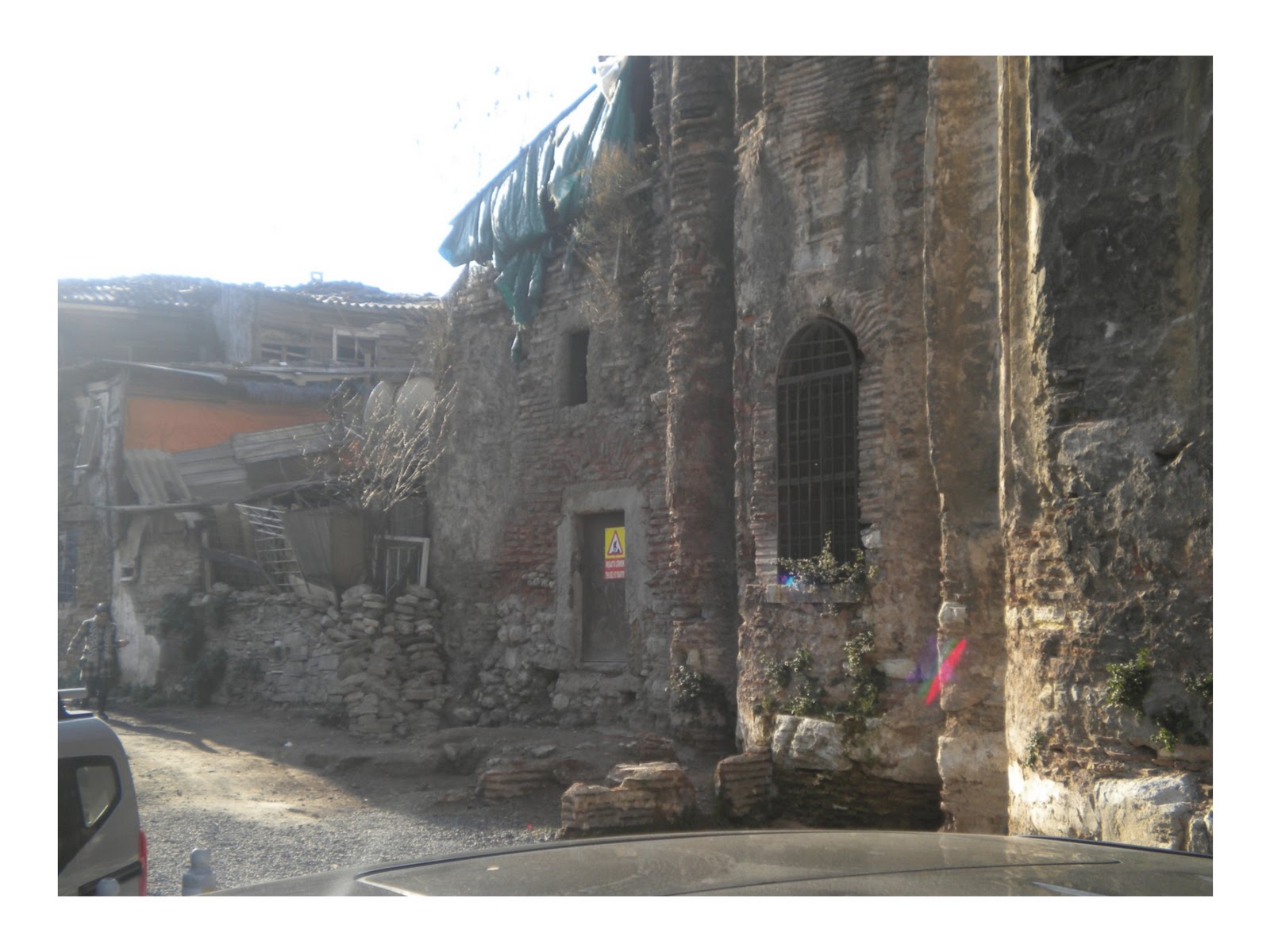
Old caravanserai in Beysehir, Turkey

Working on a fair copy of a poem in book 6 of The Song ov Elmallahz Kumming. The poem is fairly short, 36 lines, but because of some technical complexities, it has gone thru untold numbers of revisions. I'm closing in, and will publish it here, soon, with a peek behind the surface, to some of the discarded and unrevised lines. In the meantime...

I continue to work on digitizing and restoring slides of Turkey taken in 1983 and 1986. I intend to use some of them for my ebook, Ottoman Beachcomber. Yesterday I came across this image, which allowed for some surprising results. Here's the original, a shot of a ruins of a rather grand caravanserai (pre-industrial truck stop; caravan resting place) in Beyşehir (pronounced BAY-sha-heer), a small town in south central Turkey.


There wasn't much I could do with this to enhance it while remaining true to its realism. But then again, as I see it, realism is just the surface of things. With not much effort, I found a lot of color lurking behind the surface. First this:


Which quickly revealed this:


Then this:


And then finally, taking some color away, this:


Who knew there were all those gemstones in the matrix of stone and the mortar mix? In 1983 when we first came across this site, this last picture approximates what I saw. The image prior to the last one is what I speculate Nancy saw when she clicked the shutter.

Friday, May 25, 2012

multi-threaded nature of thought, 2

In the distant past, almost two months ago, I posted a little essay about the superimposing layers of thought going on in the mind at any given moment. I noted that I would post a draft of a scene in The Atternen Jewz Talen that explores this idea directly, that is phenomenologically. Finally, here it is...

Written 3/29/12, 6 Nisson 5772; week ov Tzav
Edited 5/25/12, 4 Sivan 5772, week ov Bamidbar

Like a maed az she step frum a steemee bath,
The beedz a sparkel on brest and cheek,
An she run a kome thru her glissen a hair,
Awl kleen an strate an silver a sheen,
So awl the thred an the braken strand
In my theenk untaengelz in a shivver a lite.

Nayomeez in thaer, her haer streem down
Like a milkee way, awl fiyerree faent;
An the Surah* street in a mobeyus not,
                 * Jewish sittee on the Ewfrateez till about 1000 CE
                    The Atternen Jew livd thaer mennee a yeer
Ov me an a thowzen alleez an dorz.
I wonder like a chiel lost in forlorn,
An in thoze streeten, the krush a shops,
An in them shop, mennee the fase,
An Nayomee an Ellijah a peerenz owt
Ov them straenjerren staers and fammilleyen iyz.

Them fasen like sitteez I wonder thru.
How much iz me-in-them that I see
An how much them that shine thru me?

Surah, Dammask, Allexxandreya...
Ah, Yerrushallaem, yur wawl an yur dung,
An the boyel a worz, the klatter an kry.
Menz awl werkt up, awl God insane.
An them pagen speerz stoken inflame,
Thaer fiyeree feengerz grippen my kor,
That Addom overheeten inside my braen.
An Addom, him kryen for Edenz re-bertht;
Eve in her berth thro; him plow the erth.

Thats the embroiderz a kuller it awl.
But the worpen thredz an weften kord
Az hoel it tugether in a moeshennel feel:
Deziyer - Nayomee in a silkee gown,
An sarroez - me sleepen in a foxxen den.
Despaerz a plunnee - my tatterz a faeth,
An sumhow, wunder twisten in -
The lite a-slant thru a braken dor
On a gerl-chiel tokken tu her raggee dol.
An plunnee a aengerz an thaer feerz an joyz.
Multappel korden a randem arraed,
Shapen eech theenk az it kum unmade.
Shapen me intu thaer atternen taelz
Beneeth my brokaden memmorree.

Well, thats a mor detalen skech a my theenks
Than I ment tu say ov my travvellenz eest.

Friday, May 04, 2012

Restoring the color of the past, 2

In late March of this year, I posted an image recovered from my wife's slide archive, showing the Sultan Beyazit Cami (mosque) in Amasya. I then showed my progressive restoration of the image. (Well, really, some may argue it was not restoration so much as transformation, re-creation.)

Below are a few more notable images recently digitized and then restored/transformed by me. Some or all of these will end up in my ebook, Ottoman Beachcomber (which has also been previewed in this blog)....

Food market in Bergama, original:


Bergama market, newly alive:


Divrigi, dawn, almost:


Divrigi, dawn, really:


This is a cool pic. Nancy climbed the minaret of the Uc Serefeli Cami (mosque) in Edirne, and took a picture across town of the Selimiye Cami. First the original long shot:


Here's the Selimiye close-up (cropped from the original):


Now, here's 3 more of the Selimiye, transformed (definitely NOT simply restored):


Way down yonder in southeast Turkey is Mardin, an ancient town high up on the plateau overlooking Syria. Here's the original, a shot of some people (almost) and the Syrian plain in the background:


Now we can see the people, too. HEY, that's me, with some pals!


Finally, a beautiful shot of the Ishak Pasha Saray (palace), which needs little or no attention:


Buuuut... I gave it some attention anyway. Here's 2 new ways to see Ishak Pasha:


Click on any image to zoom it, and/or to see a slide show of all the images in this post.

Wednesday, May 02, 2012

Educational tours of the USHMM

Yesterday I led a group of nineteen 8th graders through the US Holocaust Memorial Museum, on a rigorous educational tour. What a great group of students!

One of the exhibits is a room full of shoes with a 5 line poem on the wall written by Moishe Shulstein. The poem, written from the point of view of the shoes, stands as the primary documentation for the exhibit. To counterpoint the poem as a way of making it stand out, and as an exercise in helping the students filter through the vast number of images they had seen so far, I had them each write a poem, written from the point of view of an animal. They had 5 minutes to write something.

The following students gave me permission to publish their poems on my blog. Here they are, unedited. Given the short amount of time they had, perhaps you might be inclined to change a word here or there, but still, I think you’ll be as blown away as I am.

I fly over them,
they are treated so awfully
why do they cry
all I can do is watch
because I am JUST
a bird and they are
JUST Jews.
- - - Daniel Benzikri

BEE
I am a bee
I buzz and I sting
I cause so much pain
I hunt prey
I stand by letting people fall below
I am powerless
It is custom for me to cause pain,
but, is it right?
I am a bee,
I am a Nazi.
- - - Ophir Mizrahi

I have seen things no one
else should ever see. I have
seen only bad things for
the last 6 years. I have
seen bodies fall to the
ground after a loud shot.
I have also seen how
bodies have been thrown
into pits. Nearby, I
always see black smoke
coming out. today there
is no more of that.
I can hear celebrating.
There is freedom after all.
- - - Moses Goodman

Sparrow
As I fly
as free as can be
I look down,
and see a terrible thing
As I move through the ocean breeze
It troubles me what I see
I see children dying,
people crying
As the smoke flies up
to me.
I cry, for those who
can’t.
- - - Gilana Pikover

I fly over the camps
Most disgusting thing I ever saw
How can people be so mean?
- - - Tamir

I am a fox
I was spared because
of my weakness (?) and
my intelligence
I have not been killed
because of my uselessness.
- - - Matthew Levy

Monday, April 02, 2012

multi-threaded nature of thought

My reading, reflecting my interests, spans a wide range of topics. However, the subject of thought – what it is and how we experience it - is almost entirely unexplored (with the exception of some lame and poorly written philosophical treatises on "mind"). It appears that, in large measure, most people think of "a thought" as a distinct, precise, and unalloyed unit, not unlike the idea of the "atom" as imagined in the late 19th century.

That late 19th century "atom", it turned out, is not the ultimate building block of matter, and indeed will probably end up being seen as a fictional unit altogether, discarded from scientific discourse. So too, it is becoming clear that our thoughts are not singular, fundamental units of consciousness, but are complex fabrics woven of many strands and fragments. Or to use another analogy, our thoughts are like symphonic compositions, with multiple instruments playing independent but related, or semi-related consonant and dissonant melodies, tones, and percussive beats.

This understanding of thought is derived from my direct experience, and emerges from the comprehensively documented observations of the highly superimposed nature of consciousness. To use a computing metaphor, human consciousness is a multi-tasking system, and each task is multi-threaded. At any given moment, consciousness is composed of multiple sensations, emotions, thoughts, and higher-order impressions and operations (these latter being beyond the threshold of common awareness), and each sensation, emotion, and thought is multi-threaded.

Most of the time most people are entirely unaware of this symphony of processing going on within them, that comprises human mentation. Indeed, we are wont to reduce this welter of processes to single thoughts, or single emotions, or single sensations, or at most, single (mostly) linear narratives. The arts, of course, challenge this kind of simplification. As noted, the symphony with its multiple instruments playing multiple melodies, phrases, and sounds replicates the multi-threaded nature of human consciousness. The novel, with its complex interacting characters and interwoven story lines replicates both the multi-tasking and multi-threading of consciousness. Yet, nowhere in literature, at least to my knowledge, has this exploration of complexity focused down into the multi-threaded functioning of consciousness itself. At most, we have stream-of-consciousness techniques exploring the uppermost level of awareness and its often non-linear narrative trajectory. 

Having introspectively explored my thinking processes for over 40 years, it seems appropriate (perhaps long overdue) that I now take my perspective down into the multiple threads of thought to try to unpack them. Perhaps the subject may seem more appropriate for a psychological essay or a phenomenological tract. But those forms lack both aesthetic richness and narrative ordering principles, and aesthetics and narrative are core components of consciousness. Therefore I am exploring these horizons of consciousness through a poetic lens, hoping, through a sort of stop-frame process, to expose a more accurate and nuanced representation of human mentation.

In my next post will you will be able to read (and critique) a first draft of just such an exploration.

Tuesday, March 27, 2012

Restoring the color of the past

I am in the process of digitizing my wife Nancy's slides of Turkey from 1983. They are the pics she took while we traveled around the country, she working on her dissertation, and I writing scenes for Ottoman Beachcomber (to see previous posts on this topic, CLICK HERE). Due to the age of the slides, and perhaps less than favorable photographic conditions at the time, the slides are rather washed out, and they seem to have drifted into the purple registers. For example, here's a picture of the Sultan Beyazit Cami in Amasya:


It's a nice enough picture, but, I think you'll agree, it lacks pizazz. So I started working on it, using Gimp. Step 1:


Not a big change. You may not even notice it: telephone wires gone. Step 2:


Now, that's more like it. This is a beautiful mosque made of gorgeous stone. Step 3:


The mountain in the background recovers some of its fire. And notice, the wagon's delightful paint job is now visible. On to step 4:


Do you see the change?? The boy vanishes! Now step 5 is perhaps a little much, but bear with me:


Is the sky over-bright? Maybe, but I'm not done yet. Now we get to the fun part, making this a visionary experience:


And still one step further:


This is what the world feels like and seems like when you're traveling out on the edge, having the time of your life. The camera may only see that drab first image, but that's not the truth when you're traveling almost-out-of-body!

Wednesday, March 14, 2012

Book of the Dead, a scene

I am working on a new story, part of my book, Transmigrant Journals. This story, The Book of the Dead, Frayed Ends of a Broken Thread, is made up of a number of short, interwoven but non-linear scenes. Here is one:

Reading Akutagawa’s The Story of a Head that Fell Off. When I nod off, I dream I am Xiao-er. I am lying in mud by the edge of a gentle stream. Willow leaves tremble above my head. I dream I am dying, no, that I am dead and I have washed up on an unknown bank. Realizing this, I am struck by a bolt of panic, and I jolt awake.

Swallowed in grief, I look about me and see I have been lost in a reverie. This moment is too piercing. I am at graveside, and the casket has just been lowered. The shovel is lifted by person after person, each struggling to drive its blade into the wet clay and rock, to lift it, to shake its load into the grave, to drive its blade back into the clotted earth.

I pull the shovel out of the muck, then drive it back in with a violent shove. As I lift and throw, I see the casket is open. Horrified, I drop the shovel and it clatters into the open pit .

Swallowed in shock, I open my eyes. I am lying in mud by a gentle stream.

Sunday, March 11, 2012

Ottoman Beachcomber: an Afterword

The following text is the afterword to my latest little ebook, Ottoman Beachcomber. Of course, in the ebook there are images, links, and jumps to other parts of the text, which I left out here. The original text was written in 1983, when I traveled from Beograd, Yugoslavia to Edirne, Turkey to meet my wife. We then traveled together for 4 months around Turkey. 

In the 29 years that have transpired since then...

Much has changed since these stories were written, in matters of appearances and accessibility, as well as in politics and cultural awareness.

Yugoslavia, the model conglomerate state, has been shattered into recriminating pieces. Turkey, seemingly content and proudly secular, looks longingly back to its religious past, with idylls of the caliphate and imperialism. Prizren, Skopje, Edirne, Bergama, Izmir – largely unknown when these stories were written, are now on the itineraries of all the hipster travel guides. Greece, once a magnet for hipsters and vagabonds, now implodes beneath the weight of its own political and social vagabondism. And yet, I wonder if I would still be followed by a gang of affectionate, laughing kids, walking around Tokat. I’m inclined to think I would.

I decided to embed the text with links, to help provide a little intellectual fill-in (eg, Wikipedia articles), and to enrich it with accessible public images (beyond Nancy’s photos). How often I laughed out loud, seeing exactly the object or building or valley that appeared before my eyes 25 years ago, unchanged, except by the embellishments of my, perhaps, over-active imagination. Or I would groan, or just sag back in my chair, seeing other places modernized into oblivion.

A few salient examples may help you appreciate how ephemeral both time and place may be. Often, all that remains are the descriptive and literary reconstructions of it, shaped by the author’s interests, sensitivities, and transient emotions.

My first epiphany was in II. Moving Fast, when I wondered if there were any images of Kraljevo online. HA! There was even a video put out by the Turist Hotel, featuring in its opening scene the “larger than life statue” I mentioned. Talk about a long, delightful chuckle with oneself!

In IV. Saloniki, Almost, I explored dozens of websites trying to find and verify images of the caravanserai I explored. In the process I hit upon a photo of the Ottoman bath cum art gallery, almost a perfect replica of the drawing I had done of that very place. I immediately scanned the drawing from my notebook, and embedded it and the link to its online counterpart into the chapter. That was really gratifying.

I also lucked out in V. A Typical Border in a Typical Daydream, and found a picture of the customs house and surrounding landscape just south of Gevgelija. You may not be able to see the  exotic people, party and sunrise in that picture, but it flooded my mind for over an hour with reveries.

In IX. Turkish Valleys and Yellow Brick Roads, I had little hope of finding a picture to illustrate the stunning hill of olive trees with retaining walls, but I literally jumped up and shouted jubilantly (startling my wife out of sleep with many a grumble) when I came across the one I linked to at “grove on the steep hillside”. It seems someone else has a sensibility similar to mine.

I experienced a few notable disappointments. Back in the early 80's the ferries that plowed the Bosporus genuinely belched smoke and sparks in thick abundance, but thanks to environmental concerns, all those ferries have been converted to cleaner fuel. Am I complaining? Nonetheless, I couldn’t find a single image of those cinder belchers. I’m sure they were widely photographed, and no doubt, they may be well documented in online archives (and more certainly, they languish and fade in boxes in a thousand households full of old, forgotten snapshots) but no such images are to be found in easily accessible sites. I had to settle for an unconvincing and uninspired shot (“belch from the smoke stacks” in X. Fishermen and Their Wharves) that doesn’t do justice to history.

Another disappointment occurred in XI. The Izmir Fish Market. It seems, the central fish market on the Izmir harbor pier doesn’t exist anymore. I had to settle for some “it was kinda like this” images. Tempus fugsus.

Finally, Turkey’s change over the last 25 years was, for me, most dramatically displayed as I searched for images of the town of Divrigi (XII. Oases and Caravanserais). When Nancy and I explored it, it was a mud brick village, which seemed almost prehistoric in our romanticism. I tried to convey that through a link to an historic photo, but that destitute town seems to have gotten a professional facelift. Looking at it now, you might think you were in some out of the way place in Tuscany. Not bad, but not my Divrigi.

Finally, I would like to acknowledge the remarkable photo archives at www.pbase.com, which I linked into the text a number of times. They will jump out at you as you come across them, and you may find yourself diverted from my little history for more time than I had intended.

Friday, February 24, 2012

excerpt from Ottoman Beachcomber

I have been working on converting a travelogue I wrote in 1983 into an eBook. This is not simply a matter of conversion into xhtml from standard word processor format. An eBook should be more than simply an electronic version of a physical book.

In the case of my travelogue, Ottoman Beachcomber, this means embedding links into the text, to explicate places with public knowledge and images. It also means digitizing drawings from my notebooks, to embed in the story, as well as digitizing my wife's prodigious collection of 35mm slides, many from our travels in 1983, again to illustrate the text.

While I have not yet digitized the slides, the following excerpt will give you a taste of the many virtues of eBooks. Clicking on the link-colored text will take you to explanatory or illustrative internet resources. Of particular pleasure to me is the drawing I did of the Contemporary Art Gallery in Skopje, which you can see below. Compare that to a photo I found in Wikipedia of that very same gallery, the "Ottoman bath" link in my text, taken recently!

I hope you enjoy the short excerpt below as much as I have enjoyed researching the places and times described.

IV. SALONIKI, ALMOST

Gevgelija.

My intention was to go from Prizren to Skopje to Saloniki, a city 70 k's inside the Greek border. It would be a very long day unless my connections were good.

I woke at 5:41 to catch a 7:00 AM bus, and it was easily done. I reached Skopje by 10:00. However, there was no bus leaving for Saloniki till 2:30. I could get a direct bus at that time, but it would be four times as expensive as taking a bus (or train) to the border, walking across, and getting another bus in Greece. That's the way it works in these here parts. So I walked to the train station and found that the next train to the border was at 3:30. In spite of the hour delay, I decided on the train. I had been told it was more convenient. I checked my bags at the very modern Skopje train station (the old one had been shaken down in a 1961 earthquake), and set out to explore. A tourist map showed an art gallery, 300 year old mosque, and a caravanserai clustered fairly closely together and about a 20 minute walk from the train station. The district I was exploring also had a wonderful, large, open air market. It consisted of a number of picturesque winding alleys built into some Ottoman ruins, filled with an unending assortment of shops and goods. I especially noticed some antique jewelry shops with exceptionally fine old filigree work. In fact, I had never seen anything nicer, but then again, I'm not a regular at Sotheby's. I drank little glasses of tea in two tiny, wood panelled 'chai' shops as I wandered around the antique alleys.

Just outside the market was the caravanserai. This was a treasure! It was fully intact and preserved, but even better, each little room (about 60 in all) was filled with archaeological finds, exclusively stone and tile. There were Greek, Roman, Byzantine, and Ottoman architectural fragments, gravestones, statues, and who knows what else. It was free and I was the only person there for the whole time I spent poking around and sketching. But don't imagine this was some kind of modern museum. Most of the rooms were unlighted, and nothing was labelled. It was really something between a museum and a warehouse, and I liked it like that.

Then I found the art gallery, not 15 minutes walk away. It was an extremely beautiful and well preserved Ottoman bath with 4 main rooms, discreetly plastered inside so that interesting structural and decorative brickwork remained exposed. It was a wonderful environment displaying a small assortment of modern Yugoslavian paintings.


Tuesday, February 21, 2012

My latest eBook, Ottoman Beachcomber

Ottoman Beachcomber, Travels in the Balkans and Turkey, 1983.

The world was a very different place in 1983, at least in Yugoslavia, Greece, and Turkey. In Ottoman Beachcomber you will go on travels in a simpler time to places innocent and charming. Join me as I outrun demons that are chasing me, dance in morning dew with unknown women, walk across borders in the dead of night, find my estranged wife in a 15th century Ottoman marketplace, and explore delightful villages far off the beaten trail.

Here's the cover of the book:

Friday, February 17, 2012

Forgive my nostalgia

While working on xhtml and css coding, and latest excursions in the Atternen Jewz Talen, my screen slideshow-background made me stop and sigh...

These, 3 of my favorite pics, of Nancy Naomi and her boys:

NM's graduation day from U. Penn, PhD, mid 80's, and *I* get to hold the diploma!

On Gert's patio, late 80's, with that, already, amazing guy, Josh.
On the grandstands behind our Victoria house, mid 90's: that incredibly cute munchkin with his mom.


Thursday, February 09, 2012

2 new ebooks of my writings

I have been working with a cloud-software package called Vook, now in beta (and very nice to use) to produce two short ebooks (about 30 pages each).

The first is the opening scenes of The Atternen Jewz Talen, Era 1. The text is presented in both stevespell and normspell, stanza by stanza. Also, each stanza is followed by an embedded audio file, giving a reading of the stanza. If you hear it as you read along, I think you'll be amazed that the text is really quite accessible, in spite of appearances.

Here's the book's cover:
  
The second book is A Pilgrimmage Tu Jerusalem, Fragment of a letter from a pilgrim tu his rebbe. This is an amazing text I discovered many years ago. I won't say much about it here, except that it's a letter I found, and compared to my poetry, it's easy reading. Here's the cover image from the book:


Both books are also liberally, and dare I posit, attractively illustrated. I think they're very beautiful books to look at and to read. We are in the midst of a Gutenberg transition in the nature of books, and while I have heard many people bemoan the demise of the physical book -- its beauty, its art, its texture, its feel and smell -- and while I too am in love with physical books (having written, calligraphed, printed, bound, and conserved them over the years), the ebook is a great new adventure in books and reading. And I hope to keep my own ebooks at the forward edge of the art, rich in ideas, beauty and utility.

Contact me if you'd like an epub version, readable on iPads, Nooks, or with Calibre and other software packages on your computer. My email address is in the right margin of this blog, just below the "About Me" text.

Thursday, January 26, 2012

Two psychological observations

These two pieces from my notebooks come nearly 35 years apart. One is from today, one from July, 1977.

1/26/12, 2 Shevat 5772, week of Bo
Four critical and fundamental errors in human analytical thinking:
1. The confusion of emotional attachment with ‘facticity’, truth; vis belief in God becomes dogma and supporting evidence (Bible) becomes incontrovertible; or, feelings of love can cause us to mis-see and misunderstand the person that is loved and the situation in which that love exists.
2. Confusion of emotional intensity for degree of certainty; vis the more comfort one derives from belief in God, the more certain one is of God’s existence; or, the more desperate our need for companionship, the more certain we may become that someone loves us.
3. The confusion that personal perspective is ‘true’ and co-equal with universal perspective; vis the certainty that whatever political beliefs one inclines towards, those beliefs are the correct (or better, CORRECT) way of understanding the situation.
4. The confusion that consciousness, observation, is an unmediated experience, and NOT an interpretive, filtered, and often profoundly limited or occulted experience; vis, the belief that what we see with our eyes is not merely real, but unimpeachable and unbiased ‘fact’.

Antidotes to ingest liberally:
1. facts all come with a point of view
2. observation and interpretation are co-equal
3. emotion is the carriage upon which all thought rides
4. there is no such thing as a single and pure emotion; all emotions resolve into other emotions

Trained philosophers and psychologists who reject or denigrate emotion and extol reason are equally subject to these four confusions. Emotion is a fact of consciousness, shaping and coloring it, whether it is obvious or not, whether it is intense or subtle, foregrounded or undertoned. It is there shaping, coloring, focusing, distorting, transforming, hiding the inputs of experience. Reason distinct from emotion is a conceptual illusion, a false ideal, a Newtonian distortion of the quantum mechanical nature of consciousness/reality. (I use ‘quantum mechanical’ here as a philosophical and psychological model of thought, and not merely as a way of studying matter and energy.)


7/3/77, Kayseri, Turkey
Symbolic thought:
Human consciousness is determined and constrained by density of thought. Density of thought means the number of conscious images and thoughts occurring in a given period. Even in highly exciting moments like the minutes before a race or curtain call, or the seconds before an auto-collision, there are only so many thoughts that consciously pass thru the mind. The actual number seems constrained by the normal activity of mental exertion The more one is able to concentrate, the more concentrated thoughts can be, ie, the denser the thoughts become. Like a thread or wire or beam that can hold so much tension [or transmit so much data - smb, 2012], so our consciousness can endure only so much stress. Beyond that limit it snaps, or blanks out; the system crashes. That limit can be extended by active practice of methods of concentration, however.

But this is the essential point: increased thought density does not work on a linear or algebraically continuous basis. At some point the many thoughts condense or merge into one or a few thoughts or images, like changing energy levels in an atom or molecule. One increases to a limit the number of thoughts per moment and then, remarkably, they condense into a symbol or archetype, and the working number of thoughts suddenly reduces [the ‘aha’ moment; epiphany] and the [potential] intensity of thought increases on an equivalent basis. This is a functional (phenomenological) description of the formation of symbols and symbolic thought.

Sunday, January 22, 2012

Cover to my new ebook, The Atternen Jewz Talen, Era 1


And here's a brief summary:
This book contains the opening pages of the diaries of the Eternal Jew (aka the Wandering Jew). In the opening scene he describes Jerusalem in his youth, as it was in 30 CE. He then recounts his meeting with a revolutionary named Jesus. Realizing he has left out some critical information, he turns back to the origins of humanity, telling what he knows about those early days.

This is not the Eternal Jew you might have heard about from unreliable or hate-mongering sources. He is a wise and engaging fellow, proudly Jewish, with a biting wit, and a wry but mystical view of worldly events and his place in them.

The story is told in two versions. The original text is an altered English where words and ideas morph, one into another, using a strictly phonetic spelling. To help the reader, however, a translation into standard English follows each stanza. As a further help, each stanza is followed by an embedded reading, so one can listen to the story, and read along at the same time.

The story is further enriched by beautiful graphics, and selected scans taken directly from the author's notebooks. The final chapter of the book is a collection of useful source material and links for further study and exploration.

Copyright info:
Text Copyright © 2012 for Stephen M. Berer
Audio Copyright © 2012 for Stephen M. Berer
Colorized images Copyright © 2012 for Stephen M. Berer

Friday, January 06, 2012

Back to the Crossroads. An Istanbul Journal.

“...And I went to the crossroad, momma.
I looked east and west...”
– Robt. Johnson

We sank into a cloudbank. Couldn’t see a thing till we touched down. Mid afternoon and thick gray skies scowled like the grizzled faces of Turkish men. No reason to be intimidated. Got some bozuk para, literally “broken money”, Turkish for change, for our 100 lira bills, and bought 2 jetons each, one to enter the subway, one to transfer to the tramway. Thus we began to break the rust off our Turkish, lain dormant for years, and let ourselves get swept into the undertow of Istanbul.

Uncharacteristically, we were traveling heavy, a bag and a suitcase each. School. Writing. Work. The various boulders on our shoulders. We clambered onto the tram which was empty – not for long – taking up far more than our fair share of space. Now the visuals of Istanbul began to pour down on us, all the little shops, restaurants, vendors, narrow alleys, crisscrossing pedestrians packing the sidewalks and slithering through insane traffic.
The neon signs;
The half dressed women on posters and newspapers; fruit piled elegantly on vendor carts and at the entrance to fresh grocers;


the steaming buffets showing off orange lentil soup, cooked beans, various kinds of stuffed eggplant and zucchini (dolmas), lamb stews, roasted chicken, and, of course, the donar (gyro) grill sizzling and dripping its hot juices.
The textile district, revealing and concealing, looking west and looking east;
the jewelry district, bangles piled high, glinting gold and false gold;
the plumbing supply district, with toilets lining the streets, then faucets, then pipes and tools;
cables and electronics, candy, toys, borek; shop after little shop; flashing signs, electronic and neon; hand-painted signs hanging a-kilter from their mounts; placards and graffiti; all densely layered, as we coiled thru this city, often seedy, sometimes seeming to be put together, but just barely.
Then as we approached historic Istanbul, the ancient buildings began to appear;
walls of brick and stone rubble, sagging or disappearing into crumbling poured concrete structures;
gaping ruins; 
ornate 19th century apartments, 4 and 5 stories tall as if we were in Warsaw or Budapest;
mosques, built in consecutive layers of stone and brick, their wide domes plated in lead, their single minarets with steep conical tops.


And finally, finally, with the tram totally dolmastir (stuffed, like a dolma), we began to descend to the Sultanahmet district, tourist haven with all its stunning Roman, Byzantine, and Ottoman landmarks: Hagia Sophia, Blue Mosque, Beyazit Mosque, covered bazaar, hippodrome, Basilica cistern
where, back in the 70's all the hippies would meet at the Pudding Shop and room at the Hotel Gungor, with its dorm-style rooms, now long gone after multiple facelifts have miraculously converted funky Sultanahmet into the destination of choice for the well-heeled and the chichi set.


Unconcerned with our musings and sensory overload, the tram descended further, all the way down to the Bosporus (the Bos) and the Golden Horn, to Eminonu station and then across the Galata Bridge. Just beyond the bridge we pushed, shoved and bumbled our way off the tram at Karakoy.

Now the hard part. Our apartment was half way up Yuksek Kaldirim, an incredibly steep, narrow road winding its way from the water up to the heights of Istiklal Caddesi (pronounced Jahdessee), passing the Galata Tower along the way. But surprise! Reinforcements. Our son Josh and his girlfriend Rachael met us at the tram stop, and helped us drag our millstone baggage up the hill, and then up the 5 stories of our walk-up apartment building, 19 steps per story, 95 steps in all. Breathless, and certain of us perhaps a wee bit cranky, we arrived at the dingy landing of our apartment, our home for the next 11 days.

This is at least the 7th time I’ve been to Istanbul. The first time was in 1970. I cruised in on a motorcycle that time, on my way to Afghanistan (don’t ask why; you don’t want to know). Well, that first night in Istanbul I met up with a very friendly Turk who offered me all kinds of inducements and imbibements, (“yu, me brutherz, yu, me frenz; yu sleep me bed, yu eat me food, yu smoke...”) which, some hours later, resulted in me fleeing his apartment in not the best of conditions, while he staggered around waving a gun. Careening down innumerable stairs, banging on doors till I found the exit, and out to the street, I was now lost in the back alleys of Sultanahmet, out of the frying pan into the fire, because now 3 thugs in the alley began to chase me, loping, then running as they closed in on me, finally impossibly finding my way to the hippodrome, the Hotel Gungor just 200 yards away. I jumped into a group of 4 old gomers who were coming out of a tea house, but that didn’t deter the 3 thugs, who grabbed me, flashed their badges, and shouted “gimme the money, Lebowski” oops, wrong channel, “gimme yu hashish; now!; gimme, gimme!” and they rifled thru my pants, wallet, shirt, hippy headscarf, but surprise, I wasn’t holding, so they knocked me down (didn’t take much, the condition I was in), waved their guns at me, and threatened, “we gonna gech yu; we gonna gech yu!” Four hours of sleep, and I fled Istanbul at sunrise on my BSA 250, tail between my legs, back to Europe. Oh blissful, oh joyous, oh thankful, I crossed the border and was met by leering Greek soldiers, who asked me where I was hiding my hashish. And me grinning right back – I wanted to kiss those guys I was so happy to be outa Turkey – I said, “Me?? You think I’m crazy.”

Really!

The whole, unexpurgated version of that story was recorded in the following days, as “The Live Adventures of Paranoid Pete.” Sadly that manuscript has been lost. Three years later I hitched across Europe, making it to Istanbul in November, 1973. I was on my way to India and around the world. I didn’t turn back that time.

Nancy has been here well over a dozen times, including living here for about 10 months in 1982-83 while she did research for her dissertation. I joined her for about 4 months of that time, glorious travels they were, recorded in my book Ottoman Beachcombings (which you can find, read, download for free at my website, http://www.shivvetee.com/reading_room/toc_reading_room.html)
Josh, our older son, has been to Istanbul a fair few times, and studied for a semester at Bogazici (Bo-ozzachee, Turkish for “Bosporus”) University here. But for an ill-starred trip with his researching mother when he was 3, this was Cal’s maiden voyage to Bos-town. Josh was joined by his girlfriend Rachael, herself no stranger here, along with Rachael’s parents, Vic and Geri, rookies.


Our days were spent wandering the streets and alleys, going to important architectural sites and museums, seeking out classic and exotic places to eat, shopping in the covered bazaar (the Kapili Carsisi, pronounced koppala charshissa), taking a ferry ride up the Bos and back.  (see my slideshow, https://picasaweb.google.com/109059116932561087569/IstanbulDecember2011)
I did a lot of writing, as did Cal. Josh and Nancy logged in a fair few hours working and meeting with professionals in their fields.

to be continued, maybe, 
exploring the following topics, maybe:
Ara Café, a drink in the Para with Hemmingway, breakfast at Savoy
Ferry trip and Ortakoy
latkes and nightly hanukiah lighting
Istiklal at night
Explorations: Rustepasha, Pantokrator, Kucuk Hagia Sophia, Sulimaniya
Museum Shows: Osmanli Bankasi - Osman Hamdi Bey; Istanbul Modern, Jewish Museum
sweets from carts, incl door of our apartment building, halka tatlisi (the people’s sweet; circle dessert)